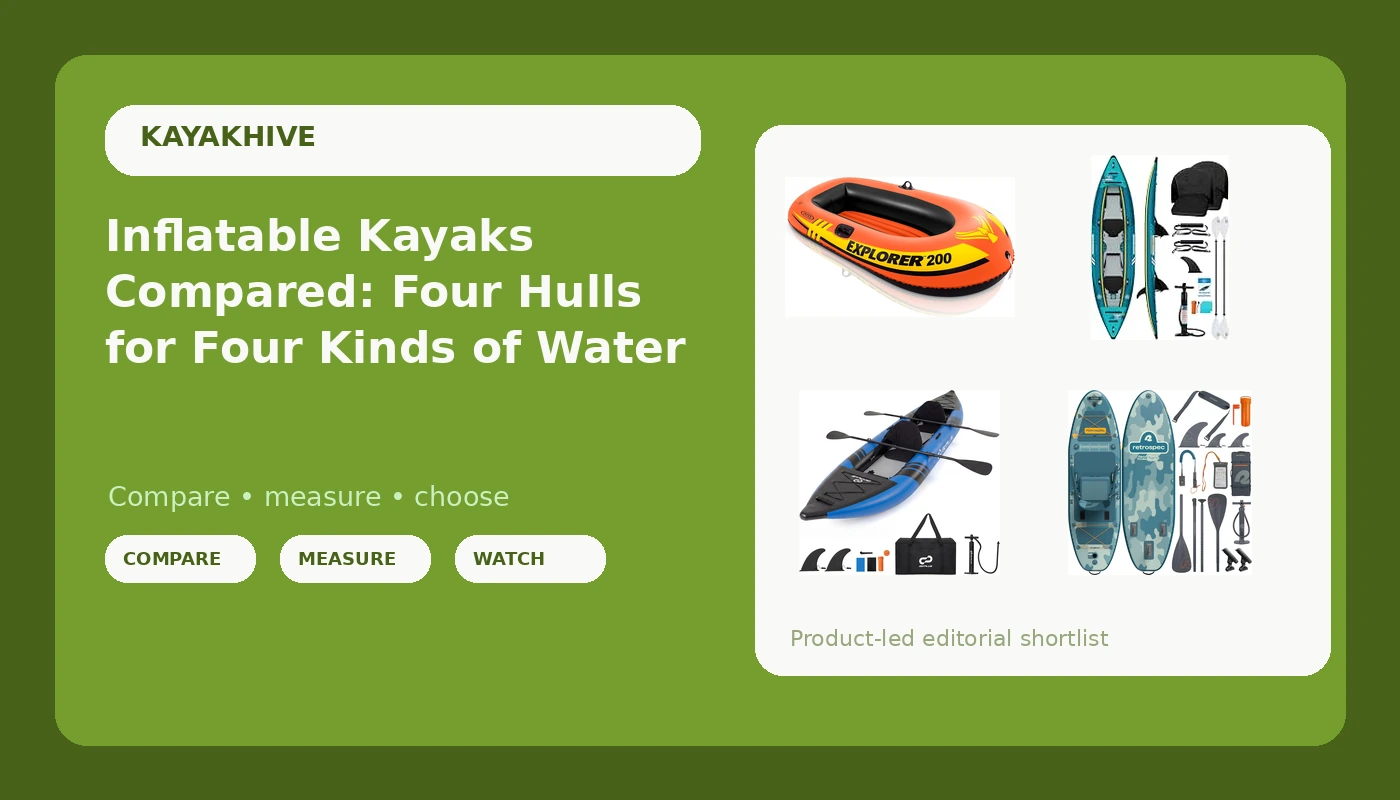
Most people shopping for an inflatable kayak are not really comparing hulls. They are comparing photos, and every photo looks roughly the same: a bright tube, a seat, a patch of flat water. The four boats on this page are not one boat in four colors. They are four different answers to four different questions, and the question you are actually asking decides which one earns its space in your garage. Inflatable kayaks compared side by side come down to construction: what the floor is made of, how the hull is shaped, who is supposed to sit in it, and how much of a Saturday you are willing to hand over to a hand pump.
That last part is not a joke. Setup time is the spec that quietly kills trips. A boat that takes fifteen minutes to bring up to pressure and another ten to dry and fold is a boat that stays on the shelf. A boat that inflates fast, holds its line in a light chop, and patches clean after an accident is a boat you will actually use. So this is not a ranking. It is a breakdown of what each of these four designs is built to do and what it will ask of you in return.
Related: How Hull Shape and Rocker Decide Whether Your Kayak Tracks Straight →
Quick answer
Match the boat to the water and the paddler before you look at anything else. A 12.5-foot tandem set suits two adults on calm, sheltered water. A sit-in touring design suits a paddler covering distance who wants spray protection and a straighter line. A 9'6" hybrid paddleboard and kayak with rod holders suits a kid or a light adult fishing a pond or a protected flat. A simple dual-chamber inflatable boat suits a first season on a lake where the stakes are low. None of these is labeled the best overall, because "best" depends on water you have not described yet.
Four useful options
| Model | Best fit | What stands out |
|---|---|---|
| Goplus Tandem Inflatable Kayak, 12.5FT 2-Person Kayak Set for Adults | Two adults on calm, sheltered water | A 12.5-foot tandem platform sold as a two-person set |
| OCEANBROAD Inflatable Sit-in Kayak(NO HIN), 1 Person/2 Person Touring Kayak | Distance and open-water touring | Sit-in deck, configurable for one or two paddlers, listed without an HIN |
| Retrospec June Nano Kids Inflatable Fishing Paddle Board SUP Kayak: 9'6" Hybrid Paddleboard with Rod Holders, Removable Seat - Lightweight Portable Youth Fishing Board | Young paddlers and casual fishing | 9'6" hybrid SUP and kayak with rod holders and a removable seat |
| INTEX Explorer Inflatable Boat Series: Dual Air Chambers, Welded Oar Locks, Grab Handles, Bow Rope, Sporty Design | A low-cost first season on flat water | Dual air chambers, welded oar locks, grab handles, and a bow rope |
Tandem pick: Goplus Tandem Inflatable Kayak
Tandem geometry is a trade, and it is worth understanding before you buy. Two paddlers on one long hull usually track straighter than one paddler on a short one, because the waterline is longer and the boat has more mass to push through chop. The cost is weight and packing volume, plus a longer pump session. A tandem is also a poor solo boat. Paddled alone from the rear seat, a 12.5-foot inflatable tends to weathervane in wind unless you load the bow with gear, and you are moving a lot of boat with one set of arms.
Touring pick: OCEANBROAD Inflatable Sit-in Kayak
The HIN detail matters more than it sounds. Many states require registration for vessels that carry a hull identification number, while some paddlecraft without one fall outside that requirement. Rules vary by state and by how the craft is used, so confirm your own local requirements rather than assuming. The other thing to weigh is the sit-in layout itself: a decked boat keeps you drier and cuts wind resistance, but it is slower to drain and dry at the end of the day, and re-entry after a capsize takes practice.
Youth fishing pick: Retrospec June Nano Kids Inflatable Fishing Paddle Board SUP Kayak
A hybrid like this is a great fit for a specific job and a poor fit for everything else. It is light, it is easy for a smaller paddler to handle, and the rod holders mean a kid can actually fish instead of balancing a rod across their lap. What it is not is a distance boat. A 9'6" hull with a wide, stable deck is going to be slower and harder to keep straight over a long crossing than a touring design, and the standing-friendly width works against you in wind.
Low-cost starter: INTEX Explorer Inflatable Boat
Set expectations here and this boat is a bargain. Low cost usually means thinner hull material, simpler valves, and a flat air-chamber floor that flexes underfoot, all of which cost you speed and tracking. It will not hold a line like a touring kayak and it is not built for rock gardens or oyster bars. What it will do is get a beginner and a kid onto a calm lake for an afternoon without a serious financial commitment, and dual chambers mean a single puncture does not put you in the water. Budget for a patch kit and a pump that fits its valves from day one.
Prices and availability may change. Product images, names, and retailer links are matched to verified listings. No current price, rating, stock status, or measured result is stated here without current evidence.
What you are actually paying for in the floor
Three floor designs show up in inflatables, and the floor is where most of the price difference lives. A plain air chamber is just that: a single bladder that flexes like a waterbed. Every stroke pushes the floor down before it pushes the boat forward, which is why cheap inflatables feel sluggish. An I-beam floor adds fabric ribs that connect the top and bottom of the chamber, so the floor can only inflate until the beams go taut, giving you a flatter surface. A drop-stitch floor takes that idea further with thousands of threads linking the two layers, which lets it hold real pressure, often in the range of 10 to 15 PSI compared with 2 or 3 PSI in an ordinary tube. At that pressure a drop-stitch floor behaves more like a rigid board than a cushion, and the boat sits higher, moves faster, and tracks noticeably better.
The catch is that the word on the box means nothing if you underinflate. A drop-stitch floor at half pressure feels like a wet noodle, and underinflation is the most common reason a brand new inflatable feels disappointing. Buy a pump with a gauge, and check the pressure again after twenty minutes in the sun, because air expands as it warms. A boat pumped to spec in cool morning air will stiffen through the afternoon, and a boat left inflated on hot pavement can push past its limit.
Matching the hull to the water and the paddler
Length and rocker do most of the work in how a boat feels. A longer hull has more waterline, which translates to straighter tracking and better glide, at the cost of turning radius and packed size. Rocker is the curve from bow to stern: more curve turns easily and rides chop, less curve tracks straighter and paddles faster. Wind is the great equalizer. An inflatable with high sides catches air like a sail, so a lower, sit-in profile holds a course better on an exposed bay, and a small skeg can fix a boat that wanders without buying a different kayak. Finally, treat stated weight capacity as a lab number rather than a promise. A hull rated for a high load with a real paddler, gear, and a cooler aboard sits lower, drags more, and tracks worse, especially on a hot afternoon when the air chambers soften.
- Count the paddlers, then add the weight of gear, water, and anything you plan to catch. Compare that total against the capacity, and leave a wide margin.
- Name the water you will actually paddle most, not the water you dream about. Sheltered lake, spring run, bay, and open coast demand different hulls.
- Decide your realistic trip length. An hour on a pond and a six-mile crossing are different sports.
- Check the floor type and the rated pressure, and confirm your pump has a gauge and the right valve adapter.
- Price the whole package: pump, paddle, patch kit, and a properly fitted life jacket all belong in the number, not just the boat.
What to check before you buy
- Valve type, and whether your existing pump fits it. A mismatched adapter turns a six-minute inflation into a twenty-minute chore.
- Hull material and seam construction, since welded seams and heavier fabric generally patch and wear better than thin glued panels.
- The patch kit in the box. Check the glue before you need it, because dried-out cement is a common and infuriating surprise.
- Drying and storage. A boat packed away wet grows mold, and mold in a storage bag is a smell you do not get back.
- Local rules on registration, required safety gear, and where inflatables are permitted, which vary widely by state and waterway.
Which option should you choose?
Choose the Goplus Tandem Inflatable Kayak when two adults will paddle together on calm, sheltered water and you want the tracking that a 12.5-foot hull provides. Choose the OCEANBROAD Inflatable Sit-in Kayak when you are covering distance, dealing with wind and spray, and want a decked boat that converts between solo and two-paddler setups. Choose the Retrospec June Nano Kids Inflatable Fishing Paddle Board SUP Kayak when a young or light paddler wants to stand, sit, and fish on protected water without wrestling a full-size kayak. Choose the INTEX Explorer Inflatable Boat when the goal is simply to get on a calm lake this weekend at the lowest possible cost and you accept the trade-offs in speed, tracking, and materials.
One caveat applies to all four: nothing here is a substitute for conditions. Inflatables are stable and forgiving, but wind, current, and cold water do not care how wide your hull is, and a sit-in deck in particular demands self-rescue practice before you take it anywhere deep.
The bottom line
The floor decides how the boat feels, the hull length and rocker decide how it tracks, and the paddler count decides which of these four you should even be looking at. If you paddle as a pair on flat water, the tandem platform makes sense. If you go alone and go far, the sit-in touring design is the one built for that job. If a kid is doing the paddling, the hybrid board with rod holders is the practical answer. And if this is your first season and you want to find out whether you even like it, the low-cost inflatable boat is a reasonable place to start, as long as you bring a pump with a gauge and a patch kit.