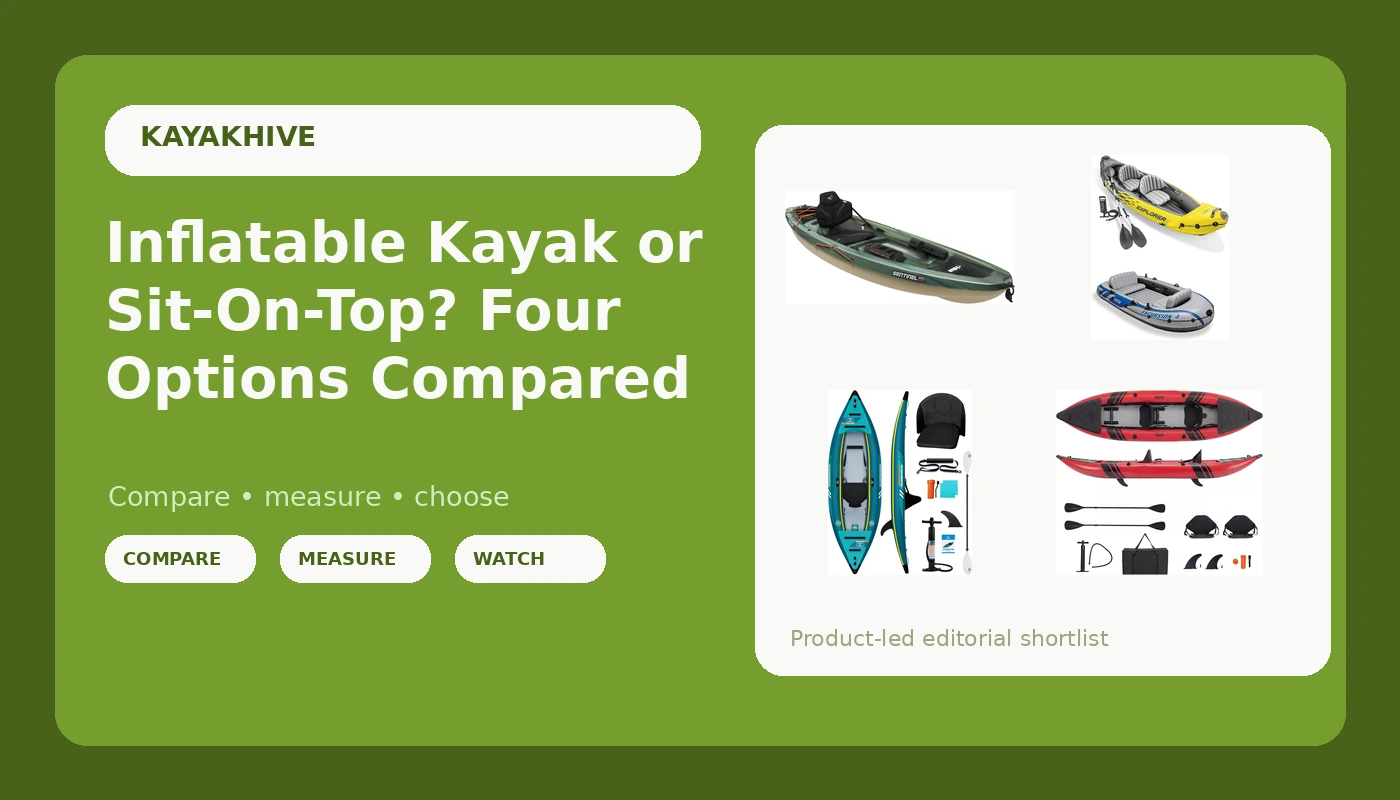
The boat ramp tells you everything. Stand at a launch on a Saturday morning and you can pick out the paddlers who know their hull: pump strokes counted, seats clipped in, dry bag already closed. Then there is everyone else, kneeling in the gravel at minute nineteen, still fighting a floor that refuses to stiffen. This inflatable kayak buying guide is built around that moment, because the four listings below solve the same problem in four different ways, and one of them solves it by skipping inflation entirely. What matters is not the color or the sticker. It is how long you stand there pumping, how stiff the floor gets once you stop, and whether the boat holds a line when the wind pushes back.
Related: How to Patch an Inflatable Kayak So the Repair Actually Holds →
Quick answer
Decide first whether you need a boat that packs into a bag or a rigid hull that never needs a pump. If packing matters, check three things on any inflatable: whether the floor is drop-stitch, what inflation pressure the maker specifies, and whether a pump, paddles, seats, and a repair kit are included or sold separately. If packing does not matter and you mostly fish calm water, a sit-on-top rigid hull removes the pump from your morning completely. The four listings here cover both paths, plus a convertible sit-in shape for paddlers who want one boat to do solo and tandem duty.
Four useful options
| Model | Best fit | What stands out |
|---|---|---|
| GYMAX Inflatable Kayak, 12.5Ft Tandem | Two paddlers who want one box to cover boat, paddles, pump, and repair kit | 12.5 ft tandem hull listed at 507 lbs capacity, with two aluminum paddles, two seats, footrests, two fins, hand pump, bag, and repair kit |
| Pelican Sentinel 100X Angler | Solo fishing on calm water where setup time is the whole game | Sit-on-top rigid hull with Ergolounge seating, so there is no inflation step at all |
| INTEX Explorer Kayak 2-Person Portable Set | Casual two-person paddling and easy storage between trips | Two-person portable inflatable set sold with an excursion inflatable boat |
| OCEANBROAD Inflatable Sit-in Kayak | One or two paddlers who want a sit-in touring deck | Convertible one or two person sit-in inflatable, listed without a hull identification number |
Featured tandem: GYMAX Inflatable Kayak, 12.5Ft Tandem
The trade-off with a 12.5 ft tandem is air volume. Every extra foot of hull is more cubic feet to fill with a hand pump, and the included pump is a starting point, not a finishing tool. Two fins under the hull help the boat hold a line, which matters more on a tandem because two paddlers rarely stroke in perfect rhythm. Treat the 507 lb figure as a lab number. Load two adults, a cooler, and fishing gear on a hot afternoon and the hull sits lower than the spec sheet suggests, so plan your gear around the water you actually paddle, not the ceiling the listing advertises.
Rigid alternative: Pelican Sentinel 100X - Angler Sit on top Fishing Kayak - Lightweight - Ergolounge™ Seating System
The catch is transport. A rigid hull has to live on a roof rack, in a truck bed, or on a trailer, and it takes up the same space whether you paddle it or not. Sit-on-top designs drain through scupper holes and let you swing your legs over the side, which is why they are popular with anglers in warm water, but you sit higher and catch more wind than in a sit-in deck. This is a solo boat in a solo category. If your paddling partner is a dog or a fishing rod, the trade is straightforward: give up packability, get back the twenty minutes you would have spent pumping.
Casual set: INTEX Explorer Kayak 2-Person Portable Set with Excursion Inflatable Boat
Recreational inflatables like this one are built for calm water and short distances. They are wide, they sit on top of the water rather than cutting through it, and they will not track like a longer touring hull when the wind picks up. That is fine for a pond, a protected lake, or a lazy stretch of river. It is not the boat you point across an open bay. The other thing to plan for is repair. Any inflatable will eventually lose air, and the question worth asking before you buy is whether the hull material takes a clean patch or tears into a spreading rip. Keep a patch kit in the bag, check the glue is still liquid before every season, and a slow leak becomes an afternoon chore instead of a dead boat.
Sit-in option: OCEANBROAD Inflatable Sit-in Kayak(NO HIN), 1 Person/2 Person Touring Kayak
The convertible layout is the appeal. Paddle it solo on a weekday spring run, then add a second seat for a weekend guest without buying a second boat. The sit-in shape also means you are sitting inside the hull rather than on top of it, which is warmer in winter and wetter to re-enter if you swim. The missing hull identification number is worth a phone call before you order: some states want a hull ID to register or title a paddlecraft, and rules vary by jurisdiction. Check your state wildlife agency's requirements first, so you are not surprised at the ramp.
Prices and availability may change. Product images, names, and retailer links are matched to verified listings. No current price, rating, stock status, or measured result is stated here without current evidence.
Why setup time and inflation pressure decide the trip
Inflation pressure is measured in PSI, pounds per square inch, and it is the number that separates a boat from a pool toy. A soft floor at low pressure flexes under your heels, drags in the water, and makes every stroke feel like you are paddling through wet sand. A stiff floor transfers your effort into forward motion. This is why the pressure specification matters more than the marketing language around it.
A hand pump moves a fixed volume of air per stroke. A longer, wider hull holds more air. Put those two facts together and you can predict your own ramp time: the bigger the boat, the more strokes it takes, and the more strokes it takes, the earlier you need to arrive. If a fifteen-minute pump session would ruin your morning, that is not a small detail. It is the deciding spec.
Chamber count is the other half of the equation. Multiple air chambers mean a puncture in one section does not automatically put you in the water, and they also let you isolate a leak later instead of guessing which seam failed. When you compare listings, count the chambers before you compare the colors.
Drop-stitch floors, hull material, and what a patch tells you
Drop-stitch is the term for thousands of polyester threads linking the two layers of a floor so it inflates board-stiff instead of balloon-soft. It is the difference between paddling and floating, and it is the single feature most worth paying for in an inflatable. That said, drop-stitch is not a magic word. What you are actually buying is floor stiffness at a stated pressure. A drop-stitch floor inflated to a low pressure is still a soft floor.
Hull material decides how the boat ages. Most recreational inflatables use a coated fabric that takes a glued patch well when the surface is clean and dry, and most of them fail at seams and valve bases rather than in the middle of a panel. That is good news for repair. A clean puncture in a flat panel is the easiest fix in boating. A tear that starts at a seam and spreads is the one that ends a season.
Keep the repair kit with the boat, not in the garage. Glue dries out in the tube, and a dried-out tube is the same as no kit at all. Check it before the season starts, not after the leak.
- Time your own setup using the pump you will actually carry, not the one in the product photo.
- Check the specified inflation pressure and whether the floor is drop-stitch or a soft panel.
- Choose solo or tandem based on your typical paddler count, not your maximum.
- Confirm what is in the box: pump, paddles, seats, fins, bag, and repair kit.
- Check your state's registration and hull identification rules before you order.
Practical guidance
- Inflate at the ramp, not at home. Air expands in the sun, and a boat filled cold in the garage can be over-pressured by the time it hits the water.
- Carry the pump even on short trips. A slow leak you can top up beats a slow leak that ends the day.
- Store the boat dry, loose, and out of the sun. Mold in a folded storage bag is the most common way an inflatable dies young.
- Match the hull to the water: sit-on-top for fishing and warm calm flats, sit-in for cooler wind and longer touring lines.
- Test your repair kit glue before every season. If it has thickened, replace it before you need it.
Which option should you choose?
Choose the GYMAX Inflatable Kayak, 12.5Ft Tandem when you want a two-person boat and a full accessory kit in one order, and you are willing to spend the pump time a 12.5 ft hull demands. Choose the Pelican Sentinel 100X when you fish solo on calm water and want to eliminate inflation from your routine, and you have a way to carry a rigid hull. Choose the INTEX Explorer Kayak 2-Person Portable Set when you are testing whether paddling is for you, on protected water and short outings. Choose the OCEANBROAD Inflatable Sit-in Kayak when you want a sit-in touring deck that converts between solo and tandem paddling, and you have confirmed your state's rules for a hull listed without an identification number.
Two caveats apply to all four. Weight ratings are manufacturer figures, and real-world performance with two adults and gear on a hot afternoon will differ from the number on the page. And nothing here is a substitute for your own timed setup. Bring a stopwatch to the ramp on your first trip and you will learn more about your boat in twenty minutes than any spec sheet can tell you.
The bottom line
The right answer depends on which problem you are solving. If packability and a complete kit matter most, the tandem inflatable with paddles, seats, pump, fins, and a repair kit covers the most ground per purchase. If setup time is the thing you refuse to negotiate, a rigid sit-on-top removes the variable entirely. If you are still deciding whether you love this, start with the portable two-person set. And if you want one hull that handles solo and tandem days, the convertible sit-in is the shape to look at, provided you check the registration rules first. Whichever you pick, budget for a better pump and a fresh tube of patch glue. Those two items decide more trips than the boat does.