Most inflatable kayak listings are written to hide the two numbers that decide whether you actually use the boat: how long it takes to reach working pressure, and how the hull material behaves the day it finally tears. Inflatable kayak setup and repair is not a side topic you get to later. It is the ownership experience, compressed into a pump, a valve, and a patch kit. A boat that takes fifteen minutes to inflate on a hot ramp stops getting used by August. A boat with a soft air-chamber floor paddles like a pool toy no matter what the product photos suggest. This explainer walks through what actually determines whether an inflatable is worth owning, how to read the specs that matter, and where four very different options fit into that picture.
Related: How to Patch an Inflatable Kayak Hull Without Making It Worse →
Quick answer
Setup time, floor construction, and patchability decide more than any color option or accessory bundle. Time your own inflation routine with the pump you actually own before you commit to a boat, because chamber volume and pump output determine whether launch day is a five-minute job or a fifteen-minute one. Look at whether the floor is drop-stitch or a plain air chamber, since floor stiffness is what separates paddling from floating. Finally, decide how much the boat's material matters to you, because every inflatable eventually leaks and the question is whether a tear patches clean or keeps spreading.
Four useful options
| Model | Best fit | What stands out |
|---|---|---|
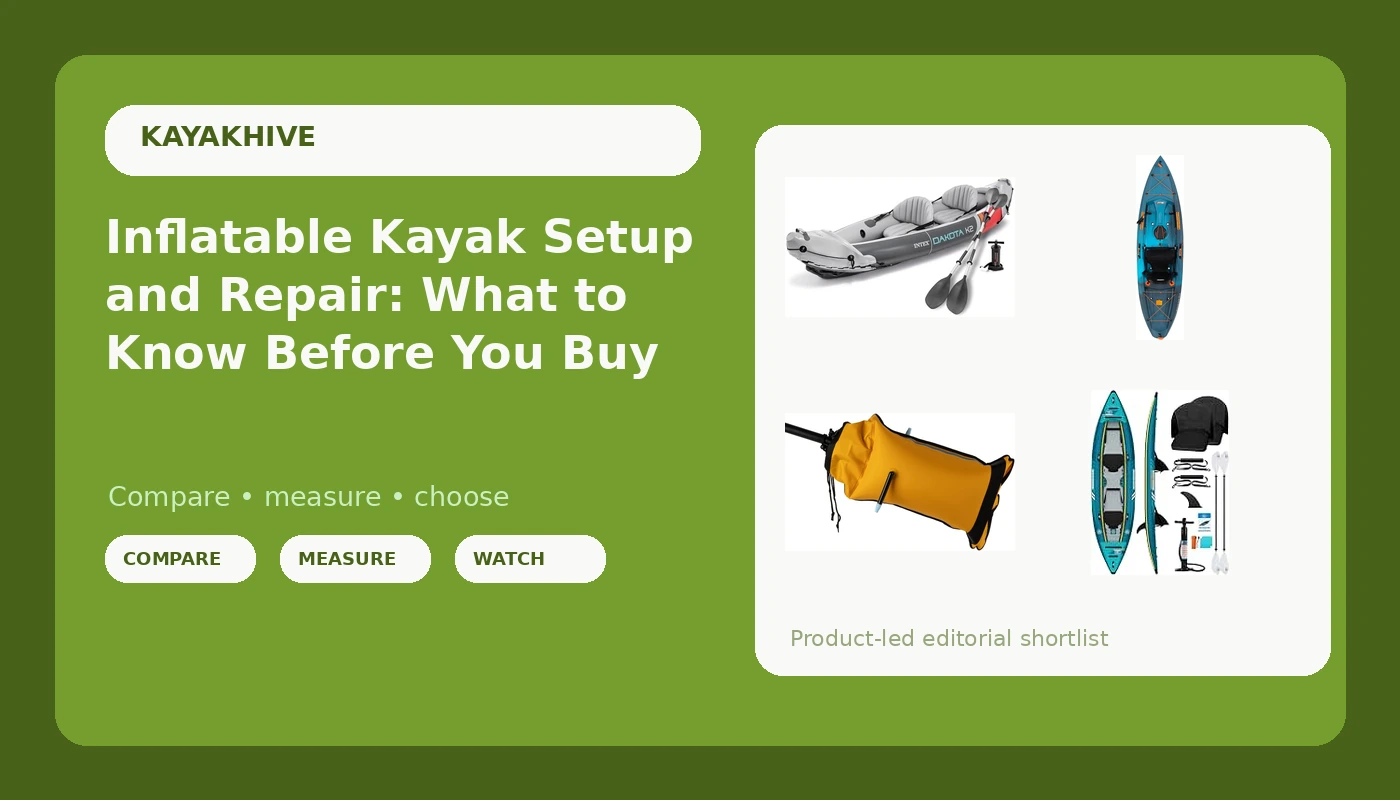
| INTEX Dakota K2 Inflatable Kayak 2-Person Portable Set with Paddles & Pump | A first two-person recreational boat where the starter gear arrives together | The set ships with paddles and a pump, so there is no separate first purchase |
| OCEANBROAD Inflatable Sit-in Kayak(NO HIN), 1 Person/2 Person Touring Kayak | Paddlers who want a sit-in touring shape and the option to run solo or tandem | A convertible one-person or two-person touring layout in an inflatable |
| Lifetime Tamarack Pro 103 Sit-On-Top Kayak, Lightning Fusion, 10 ft. 3 in. | Paddlers who want a rigid sit-on-top hull and no inflation routine at all | A 10 ft. 3 in. sit-on-top hardshell that never needs a pump |
| Kayak Paddle Float Inflatable Paddle Float Floating Bag Water Rescue Floating Bag for Kayak Rubber Boat | Anyone paddling alone or in cold water who wants a self-rescue aid aboard | An inflatable paddle float intended as a water rescue aid |
The all-in-one starter set: INTEX Dakota K2 Inflatable Kayak 2-Person Portable Set with Paddles & Pump
The value of a bundled set is that it gets you on the water on day one instead of day ten. The trade-off is that bundled accessories are chosen to hit a price point, not to match a paddler's height or stroke. If you buy this boat, plan on timing your first inflation at home with the included pump and a stopwatch, and count how many strokes it takes to get the chambers firm. That number tells you more about whether you will keep using the boat than anything on the packaging. Bundled paddles are usually the first thing an owner replaces, and that is fine, because a paddle is easy to upgrade later while a soft floor is not.
The convertible touring option: OCEANBROAD Inflatable Sit-in Kayak(NO HIN), 1 Person/2 Person Touring Kayak
A sit-in hull changes how the boat feels in wind, because you sit lower and the hull presents less of a sail to a crosswind. That matters on open water and on wide rivers where the wind runs with the current. The tandem-to-solo conversion is genuinely useful if you paddle with a partner some weekends and alone on others, but a boat that has to do both jobs usually gives up something in each configuration, so test the seating position you will actually use most. The no-HIN note on the listing is worth reading carefully, since registration requirements for paddlecraft vary by state and an unregistered boat is a problem you discover at the ramp, not at checkout.
The hardshell comparison: Lifetime Tamarack Pro 103 Sit-On-Top Kayak, Lightning Fusion, 10 ft. 3 in.
It belongs in an inflatable conversation because it answers the same question from the opposite direction. A hardshell removes setup time and puncture anxiety entirely, but it also removes the two things that make inflatables practical: it will not fold into a car trunk, and you cannot carry it up a flight of stairs on your own without a plan. If your storage is a closet or your launch is a long walk from parking, the rigid boat loses on logistics no matter how well it paddles. If your storage is a garage wall and your launch is a boat ramp, it wins on every count that involves a stopwatch.
The safety add-on: Kayak Paddle Float Inflatable Paddle Float Floating Bag Water Rescue Floating Bag for Kayak Rubber Boat
A paddle float is a self-rescue tool, not a comfort accessory. The standard technique uses it as an outrigger on one blade so you can climb back into or onto a kayak from deep water, which is a skill you practice in calm, shallow conditions before you need it in a chop. Inflatables sit higher and tend to be wider than hardshells, and both of those traits change how a re-entry feels, so the float is worth buying alongside the boat rather than after the first swim. It is also the cheapest item in this group, which makes it the easiest one to justify.
Prices and availability may change. Product images, names, and retailer links are matched to verified listings. No current price, rating, stock status, or measured result is stated here without current evidence.
The setup clock: why pump volume beats pump marketing
Every inflatable has a total air volume, and every pump moves a fixed amount of air per stroke. Divide one by the other and you get the honest setup time, which is why two boats with identical dimensions can take wildly different effort to launch. A hand pump with a large barrel and a two-stage switch moves a lot of air at low pressure and then shifts to high pressure for the final firm-up, and that combination is usually faster than a small electric pump that needs a car battery and a long hose run. The claimed "hands-free" electric pumps are the ones that most often disappoint, because they still need a power source, a hose, and twenty minutes of your morning.
The practical fix is a timed trial. Inflate the boat at home, with your own pump, three separate times, and write down each result. The third run is the real number, because the first two include learning where the valves are and how the floor chamber fills. If the third run is still long enough that you would skip a paddle rather than do it, the boat is the wrong boat for your schedule, regardless of how it looks on the water. Deflation and packing deserve the same trial, especially if you routinely finish a paddle in the rain and have to pack a wet boat.
Hull material and what patchability actually means
Drop-stitch construction links the two layers of a floor or hull with thousands of internal threads, so the panel inflates flat and rigid instead of ballooning into a tube. That rigidity is what you are paying for when you pay for a drop-stitch floor, and it is the difference between a hull that holds a line in a light chop and one that flexes under every stroke. Higher working pressure is part of the same story, since a drop-stitch panel needs real pressure to reach its stiffness, while a plain vinyl air chamber reaches its limit at a much lower number. Look for the recommended pressure on the valve or in the manual and treat anything vague as a warning sign.
Patchability is the second half. Hull materials fail in two different ways: a clean puncture that patches flat and holds, or a tear that keeps running once it starts. Material thickness, the type of glue the manufacturer specifies, and whether the seam is welded or glued all shape which outcome you get. A patch is only as good as the glue, and glue that has been sitting in a box for two seasons is the most common reason a repair kit fails on the first attempt. Buy fresh adhesive, follow the cure time exactly, and keep a spare patch and a small tube in the boat bag so a repair does not end the trip.
- Inflate the boat to its stated working pressure with your own pump and time the third run, not the first.
- Press on the floor with your palm. If it flexes like a cushion, you are buying a floating mattress, not a kayak.
- Read the valve and manual for a pressure number and a material description, and treat missing information as a cost you will pay later.
- Ask what the hull is made of and what adhesive the maker specifies, because that combination determines how a tear behaves.
- Decide where the boat will live and how far you will carry it, since storage and launch distance eliminate more boats than performance ever does.
Practical guidance before you buy
- Budget for the pump, paddle, and bag in the same number you use to compare boats, because a hull without them is not a usable boat.
- Test the paddle that comes with any bundled set before you judge the boat, since a heavy paddle makes a decent hull feel sluggish.
- Practice a wet re-entry in shallow, calm water with your paddle float before you need the skill in open water.
- Store the boat dry and loosely folded, and check the valves for grit, because a single grain of sand in a valve seat will slowly bleed a chamber.
- Keep a fresh patch kit, a spare valve, and a small hand pump in the truck, so a slow leak becomes a five-minute fix instead of a cancelled morning.
Which option should you choose?
Choose the INTEX Dakota K2 Inflatable Kayak 2-Person Portable Set with Paddles & Pump when you want a complete two-person starter package and would rather not assemble a boat from separate purchases. Choose the OCEANBROAD Inflatable Sit-in Kayak(NO HIN), 1 Person/2 Person Touring Kayak when you want a sit-in touring shape and need the option to paddle solo or with a partner in the same hull. Choose the Lifetime Tamarack Pro 103 Sit-On-Top Kayak, Lightning Fusion, 10 ft. 3 in. when you have garage storage, ramp access, and no patience for inflation. Add the Kayak Paddle Float Inflatable Paddle Float Floating Bag Water Rescue Floating Bag for Kayak Rubber Boat to any of them if you paddle alone or in cold water.
One caveat applies to all four: this article does not quote current prices, ratings, or stock status, and no setup time or durability result is claimed for any specific boat here. Verify the pressure rating, hull material, seating configuration, and registration requirements on the current listing before you buy, because manufacturers change specs and packaging between production runs.
The bottom line
Inflatable kayaks are a setup-time and repair question before they are a performance question. Time your inflation routine, confirm the floor construction, and know what the hull is made of, because those three facts predict how often the boat leaves the garage and how gracefully it ages. The Intex set gets a first two-person crew on the water with gear included, the OCEANBROAD covers the solo-or-tandem touring case, the Lifetime Tamarack Pro 103 covers the paddler who wants no pump at all, and a paddle float rounds out the kit for anyone paddling alone. Match the boat to your storage, your launch, and your patience for a pump, and the rest of the decision takes care of itself.