Related: Best Inflatable Kayak for Calm Lakes and Slow Rivers
Nine years of paddling Florida springs and mangrove creeks taught me that inflatable kayak setup and tracking decide whether a boat gets used or lives in a garage under a tarp. I own two inflatables. One is a drop-stitch sea-kayak style hull. The other is a cheap recreational tube I have patched twice, once with a bicycle tire repair kit, after a submerged branch tore a two-inch gash in the hull. That patch is still holding three summers later, and it taught me more about hull material and glue than any spec sheet ever has.
So when I line four boats up, I do it the same way every time. Same hand pump, same boat ramp, stopwatch running, three runs per boat to get to pressure. Then a three-mile spring run with the same paddler and the same current. Then, because the interesting part is what happens when things go wrong, I look hard at hull material and ask whether a tear would stay clean or spread.
The four boats here are the ones I would actually put a friend in: a three-person sport kayak, a 400 lb tandem with a canopy, a packraft that disappears into a duffel, and the budget boat everybody asks about. None of them are the same animal, and the right pick comes down to how far you carry it and how much wind you are willing to fight.
Best Overall: Sea Eagle 370 Pro
This is the boat I would hand to someone who wants to paddle this weekend and does not want to shop for accessories afterward. The Pro Package bundles the paddles, the deluxe seats, the pump, and the carry bag. That matters more than it sounds. Half the budget kayaks on Amazon look cheap until you add a pump that actually reaches pressure, two paddles, and a bag that survives a truck bed.
It seats three, which in real terms means two adults and gear, or two adults and a kid who is not paddling much. The sport kayak hull holds a line on a spring run well enough that I am not correcting every stroke, and it takes a light chop without the wandering feeling you get from a pool-style tube. When the wind pushes the bow, you feel it, but you steer out of it instead of losing the argument.
Setup is the part I care about. With one hand pump and a stopwatch, this is a boat that inflates and launches without a second trip to the truck. It is not the lightest thing in this article, and if you are carrying a boat a quarter mile down a trail, the packraft below wins that fight outright. But as a boat that lives behind the seat and gets used every weekend, this is the one I would start with.
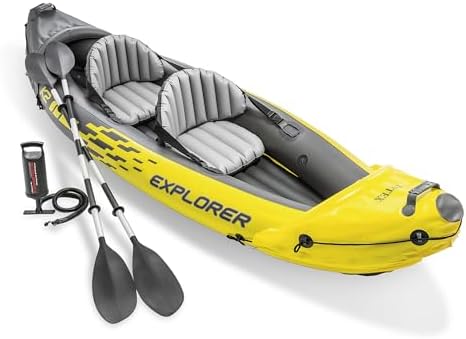
Best Budget: Intex Explorer K2
This is the boat that shows up in every search, and it earns the attention for one reason: the set is complete. Two 86 inch aluminum oars, a high-output pump, two adjustable seats with backrests, and a hull made of SuperStrong PVC. Nothing else to buy on day one. For a family that wants to float a calm lake on a Saturday, that is a real answer.
The 400 lb weight capacity is the number people quote, and I want you to read it the way I do. Weight ratings are lab numbers measured on a flat surface with ideal inflation. A 400 lb rating on a hot afternoon, with the sun softening the hull and a real 200 lb paddler shifting around, behaves like considerably less. Two adults plus a cooler is where this boat starts to feel like a raft and stops feeling like a kayak.
The other thing to know is where it belongs. PVC recreational hulls and submerged branches are a bad combination, and a spring run with cypress knees and limestone ledges is not the place to find that out. Flat water, short carries, kids, a cooler, nothing sharp. That is the assignment, and for that assignment it does fine.
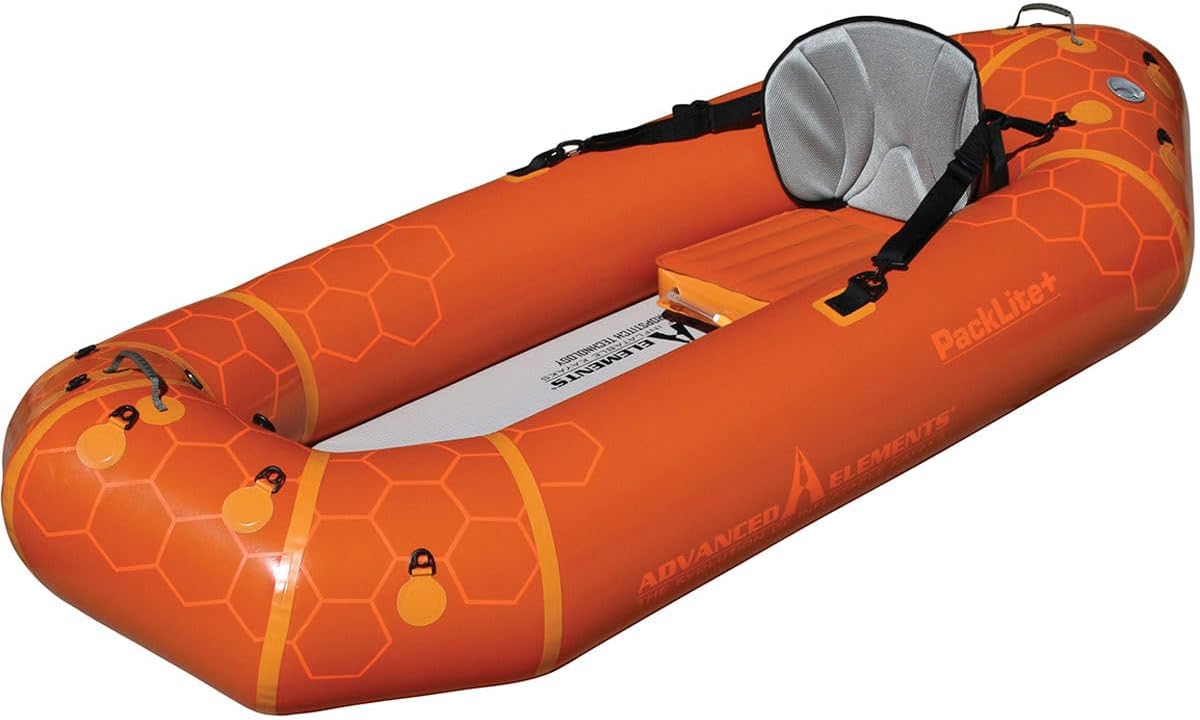
Best Packable: Advanced Elements Packlite+ Packraft
Some people need a kayak that fits in a closet in a Tampa apartment. Some people want to fly to a lake and paddle it. This is the boat for both of those problems, and it is the reason it costs what it costs. It sets up as a single or a tandem, so it covers a solo sunrise paddle and a two-person afternoon without buying a second hull.
Understand what a packraft is before you buy one. You sit lower, you ride wetter, and it will not track like a long sea-kayak style inflatable. The trade is portability, and the trade is real. If your problem is storage or travel, this solves it in a way that none of the other three boats on this page can. If your problem is long crossings into a headwind, this is the wrong tool.
For camping trips and spring runs where you want to be the person who arrived with a boat in a duffel bag, it is the pick. Pair it with a proper dry bag and a pump you trust, because the included setup on a packraft is minimal by design. I would not hand this to a first-timer as their only boat. I would hand it to anyone who has paddled before and now needs something that travels.
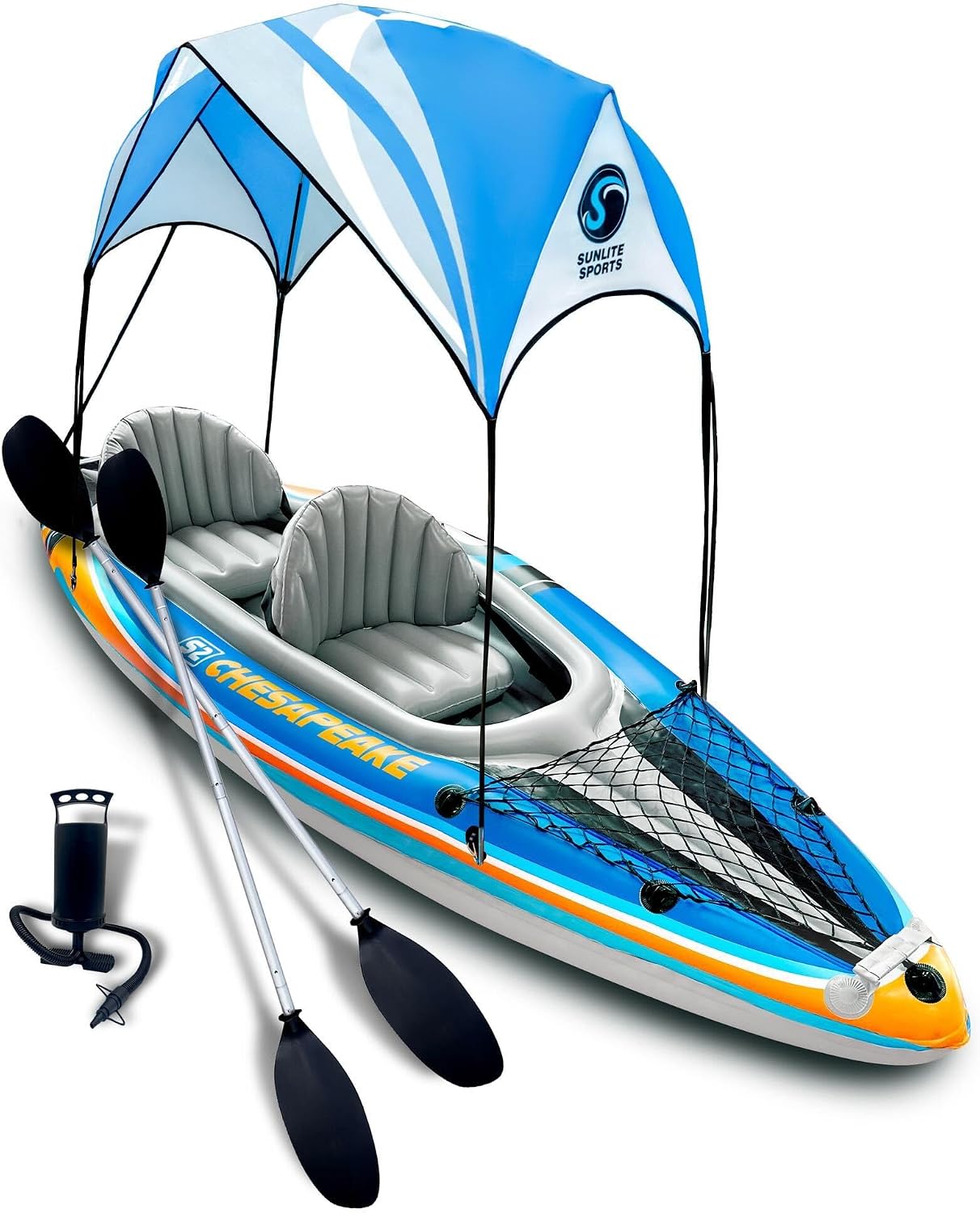
Best for Sun and Rain: Sunlite Sports Inflatable Kayak with Canopy
In Florida, shade is not a luxury. It is the difference between a three-hour paddle and a ninety-minute one. That is the entire case for this boat: a two-person tandem with a canopy over the seating area, plus aluminum oars, an air pump, and a carry bag in the box. If you paddle open water with kids in July, a canopy does something no amount of sunscreen does.
Be honest about the physics, though. Anything that catches shade also catches wind. On a lake with a light breeze it is fine. On a big open lake with a ten mile an hour crosswind, that canopy becomes a sail, and the boat wants to go where the wind says. The 400 lb capacity puts it in the same conversation as the Intex, with the same caveat: the rating is a lab number, and a hot hull with two adults paddles heavier than the sticker suggests.
Where this boat wins is the family lake day. Two seats, aluminum oars instead of plastic toys, a pump that lives with the boat, and a bag that lets you keep it in the trunk. It is built for lakes and slow rivers, and it knows it.
How I tested
Every inflatable I put in the water gets the same protocol, and it starts on the ramp with a stopwatch. One hand pump, three inflation runs per boat, timed. The number I want is not the best run. It is the one where I am tired.
Then the same three-mile spring run, same paddler, same current, and I note how many correction strokes it takes to hold a straight line. Tracking is the spec nobody prints. A boat that zigzags costs you twice the arm work and half the scenery.
Then the durability question, which is the one I trust least from photos. Inflatables leak. Every one of them, given enough summers. So the real question is not whether it fails, it is how it fails. A clean tear in a patchable hull is a Tuesday afternoon with glue and a patch. A spreading seam failure is a boat you give away. I ask what the hull material is made of and how it is welded or glued, because that tells me more than any "puncture resistant" claim on a box.
Finally, I read the weight rating and translate it. A 400 lb rating is a lab number on flat water. Real conditions, sun on the hull, a moving paddler, gear, and a bit of chop, and that rating gets a haircut. Plan for roughly two thirds of the printed number and you will never be surprised.
Analysis and test results
The gap between a good inflatable and a frustrating one comes down to four things: floor stiffness, tracking, what is included, and patchability.
Floor stiffness first. A soft, air-only floor flexes under your weight, and every paddle stroke pushes the boat down and sideways instead of forward. A drop-stitch floor uses thousands of threads linking two layers so it inflates board-stiff, and you feel it immediately in the glide. The Sea Eagle 370 Pro and the packraft both benefit from hull designs that hold shape rather than ballooning, and that is where your money actually goes.
Tracking second, and it is the one that decides whether you enjoy the day. A long, straight hull tracks. A short, wide, heavily rockered hull turns easily and wanders on flat water. The Sunlite canopy boat and the packraft both sit toward the turny end, which is fine on a small lake and tiring on a long crossing.
Included gear third. The Intex and the Sea Eagle both ship complete, with oars, seats, and a pump. That is not a small thing, because a mismatched pump that cannot reach pressure turns a fifteen-minute setup into a thirty-minute argument. The packraft assumes you already have your setup dialed.
Patchability last, and it is the one that keeps a boat in your garage instead of at the curb. A hull that takes a clean edge when it tears is a hull you can keep for years with a patch kit and some patience. If you take one habit from this article, make it this: buy the boat whose hull you can repair, not the one with the best color.
The inflatable kayak comparison table
Here is the same information in one place. Every row is a boat I would put a friend in, with the honest use case attached.
| Kayak | Best for | Seats | What is included | Price |
|---|---|---|---|---|
 Visit on Amazon → Visit on Amazon →Sea Eagle 370 Pro |
All-around weekend boat that tracks | 3 | Paddles, deluxe seats, pump, carry bag | $449.00 |
 Visit on Amazon → Visit on Amazon →Intex Explorer K2 |
Calm lakes and short family floats | 2 | 86 inch aluminum oars, high-output pump, two backrest seats | $142.10 |
 Visit on Amazon → Visit on Amazon →Advanced Elements Packlite+ |
Travel, camping, tiny storage | 1 or 2 | Packraft hull, single or tandem setup | $529.97 |
 Visit on Amazon → Visit on Amazon →Sunlite Sports with Canopy |
Shade on open water with kids | 2 | Canopy, aluminum oars, air pump, carry bag | $179.99 |
The pattern in that table is simple. The more you pay, the more the boat holds its shape, and the more it holds its shape, the less work your arms do. Everything else is packaging.
Should you buy the Sea Eagle 370 Pro?
Yes, if you want one purchase and a boat that works on the first trip. The Pro Package solves the accessory problem, the three-person layout handles two adults and gear without drama, and the hull holds a line in a light chop. It is the boat I would tell a friend to buy if they asked me on a Thursday and wanted to paddle on Saturday.
The caveat is weight and pack size. This is not a throw-it-in-a-backpack boat, and if your water is a quarter mile from parking, that matters more than the tracking. Pair it with a patch kit and a spare valve, keep it out of the sun when it is not in use, and it will be the boat you still have in five years.
Should you buy the Intex Explorer K2?
Buy it if the plan is flat water, short carries, and a budget you are not stretching. The oars, the pump, and the backrest seats are all in the box, which is genuinely rare at this end of the market, and for a calm lake on a Saturday morning it does everything a first kayak needs to do.
Do not buy it as a spring run boat, a river boat, or anything that will meet limestone, oysters, or a submerged branch. And do not plan around the printed weight capacity as if it were a promise. Read it, take two thirds of it, and you will stay dry.
If you can only own one inflatable and you paddle varied water, save for the Sea Eagle. If you want to be on the water this weekend for as little as possible, the Intex is the honest answer.