Most people who buy a hybrid kayak SUP never get the standing half to work. They climb on, push up somewhere behind the seat, feel the hull roll under them, and sit back down for good. The boat gets blamed. Usually the setup gets blamed last, which is backwards.
A hybrid kayak SUP only stands up when three things are true: the seat is out of the way, the deck under your feet is clear, and your weight sits over the middle of the hull instead of the tail. Get those right and standing becomes a normal part of the paddle, not a party trick.
I paddle the springs and mangrove creeks around Tampa almost every weekend, and I have watched a lot of people go in on a sit on top hybrid that was perfectly capable of holding them. This is the setup and paddling routine I use, in the order I use it.
Why you should trust me
I have been paddling Florida springs and mangrove creeks for nine years, and I spent my twenties as a charter fishing deckhand, which is where I learned to read a current line instead of fighting it. I own two inflatables and I have patched one of them twice, once with a bicycle tire repair kit after a submerged branch opened a two inch gash in the hull. That patch is still holding three summers later, and it taught me more about hull material and glue than any spec sheet ever did.
I keep a hand pump, a patch kit, and a stopwatch in the truck. Every boat I write about gets the same treatment: a timed setup on the ramp, a real paddle in real chop, and a hard look at what happens when something goes wrong.
How I picked and how I tested
A hybrid does not have a pump session to time, so the stopwatch moves to the launch routine. How long from tailgate to water. How long to get the seat and footwells right. How long before a paddler who has never stood on a board feels stable enough to try.
The criteria I run on any hybrid before I will recommend it:
- Does the seat actually move. If the seat back cannot fold flat or come out, standing is a stunt, not a mode. This is the first thing I check.
- Deck width and flatness where your feet land. A wide hull with a cluttered deck is worse than a narrower one you can move on.
- Trim with a real paddler aboard. I load 200 pounds and watch where the bow sits. Ratings are lab numbers.
- Tracking in a light chop. A Tampa afternoon always gives you chop. If it will not hold a line, nothing else matters.
- Wind on the beam. Sit on top hulls catch wind. A hybrid with a tall seat catches more.
I run the same three mile stretch of spring run, same current, same paddler, so the comparison is at least honest.
What a hybrid is actually good at
A hybrid is one hull that does two jobs. Seated, it paddles like a recreational sit on top: stable, forgiving, easy to fish from, easy to climb back onto. Standing, it turns into a slow, stable paddleboard for sight fishing, photography, or just stretching your legs on a long flat water run.
What it is not is fast. The width and flat deck that make standing possible are the same width that give up glide. If your goal is covering miles against a current, a hybrid is the wrong tool and you already know it.
The boat in this guide
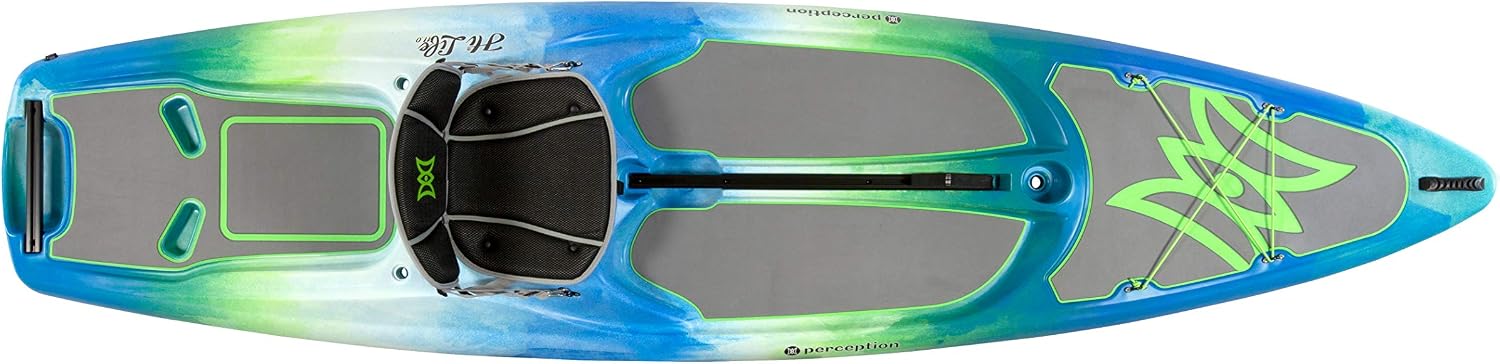
Our pick: Perception Hi Life | Sit on Top Kayak for Adults | Hybrid SUP Stand up Paddle Board Kayak
 Visit on Amazon →
This is the hybrid this guide is built around: a sit on top kayak for adults that also works as a stand up paddleboard. That is the category exactly, one hull, two ways to use it, and it is the boat I would point a first time hybrid buyer toward if they want both modes without buying two craft.
Flaws but not dealbreakers: The tradeoff is baked into the design. Anything wide and flat enough to stand on is giving up speed and glide to a dedicated touring hull, and a sit on top always sits higher in the wind than a sit inside kayak. If you want to race a current, this is not that boat. If you want to fish a flat, stand up to sight a tailing redfish, then sit down and paddle home, it is.
Anyone paddling calm springs, lakes, bay flats, and slow mangrove creeks will get the most out of it. Anyone planning open water crossings or long upwind grinds should look at a different hull.
How to set up a hybrid before you launch
Step one: set the seat before you touch the water. Do it in the parking lot, not on the ramp. Sit in the boat on flat ground, adjust the seat back so you are upright but not arched, and check that the seat can fold flat or come out for standing. If you have to fight the seat to stand, you will not stand.
Step two: clear the deck. Everything that lives on the deck goes in a hatch or gets leashed: dry bag, tackle, water bottle, camera. A loose water bottle rolling under your foot is how people end up swimming. This takes 30 seconds and saves trips.
Step three: check the footwells and scupper plugs. Sit on top hulls drain through scupper holes. For warm flat water, leave them open so the cockpit self drains. For cold water or a windy morning, plug them so you are not sitting in a puddle. Know which way yours are set before you push off.
Step four: trim the load. Weight goes forward of center when the bow is riding high, and behind center when the bow is digging. A hybrid is sensitive to this because the hull is flat. Move one dry bag and you can feel the difference in how it tracks.
Step five: bring both paddles or commit to one. A kayak paddle is what you want seated. A SUP paddle is what you want standing. If you only carry one, carry the kayak paddle and stand with it held across your deck, which is a legitimate technique and not a compromise.
Step six: leash the paddle, not yourself, in moving water. A paddle leash is cheap insurance. A board leash on a moving spring run is a snag risk, so skip it there.
How to stand up without swimming
Pick your moment. Flat water, no boat wake, no current pushing you toward a dock. Do not learn this in a chop.
Lay the paddle across the deck in front of you and grip it with both hands, palms down, like a rail.
Come up on your knees first, over the middle of the hull, not behind the seat. Knees are the stable middle step that most people skip.
Move your feet to where your knees were, one at a time, staying low. Keep your hips over the center line.
Stand up last, and keep your eyes on the horizon. Looking down at your feet is what tips people over. Your balance follows your eyes.
Keep the paddle moving. Small, quick strokes while standing give you a third point of contact. A stalled paddle is a stalled brace.
Sit back down the same way you got up, kneeling first, seat last. Nobody looks cool doing this. Everybody stays dry.
How to make it track when you sit back down
Seated tracking on a hybrid comes down to trim and stroke, in that order.
Sit up straight and rotate your torso instead of pulling with your arms. A short, wide hull responds to where your weight sits more than to how hard you pull. If the boat is weathercocking into the wind, move weight slightly aft. If the bow is plowing and the hull is wandering, move weight forward.
If your hull has a fin or a rudder option, deploy it on open flat water and lift it in shallows and around oyster bars. A fin fixes wandering. It does not fix a hull that is loaded wrong.
Where hybrids fall short
Wind. A sit on top hybrid sits high and catches air. On a breezy afternoon you will work harder than a sit inside paddler, and no paddle technique fixes that.
Speed. If your trip is measured in miles against a current, a dedicated touring kayak beats a hybrid every time. That is the honest tradeoff for being able to stand.
Standing in chop. Do not. Standing is a flat water and light chop activity. Boat wakes and spring run current are seated conditions.
Storage and transport. A wide hybrid is heavier and bulkier than an inflatable that lives in a bag. If you do not have a rack or a truck bed, measure before you buy.
What the whole setup costs
The boat is the biggest line item, and you can see it at the link above with "Check current Amazon price." Budget for the rest of the kit as part of the number, because a hybrid with no paddle is a very stable raft:
- A kayak paddle, sized to your height and the hull width. This is the one you will use most.
- A SUP paddle if you plan to stand for long stretches, or skip it and stand with the kayak paddle.
- A proper PFD you will actually wear seated and standing.
- A cart if you launch solo, because a wide hybrid is awkward to carry far.
- A dry bag for the deck, and a leash for the paddle.
The cost per trip math is the easy part. The part that decides whether you love the boat is the ten minutes you spend in the parking lot setting the seat, clearing the deck, and trimming the load before you ever push off.
The short version
Set the seat so it moves out of your way. Clear the deck. Trim the load. Paddle seated with your torso, not your arms. When the water is flat and you feel like it, come up on your knees first, then your feet, and keep your eyes on the horizon. Sit back down the same way you stood up.
That is the whole skill. The hybrid was built to do both jobs. Set it up right and let it.