Related: Best Inflatable Kayak for Calm Lakes and Spring Runs
I have been timing inflatable kayak setup on the same boat ramp for nine years, with the same hand pump, in the same Florida heat. Stopwatch in one hand, half-inflated hull in the other. Inflatable kayak setup time is the number that decides whether a boat goes in the truck or stays in the garage, and it is the one number no manufacturer prints on the box.
This guide covers the three boats I keep coming back to for three different jobs: a two-person recreational set, a solo budget boat, and a sit-on-top angler that is not an inflatable at all but keeps ending up on my roof rack anyway. Same pump, same paddler, same three-mile spring run. I timed the inflation, checked how stiff the floor actually gets at pressure, and paddled each one into a headwind to see what the tracking does when the water gets honest.
Best Overall: Intex 68307EP Explorer K2
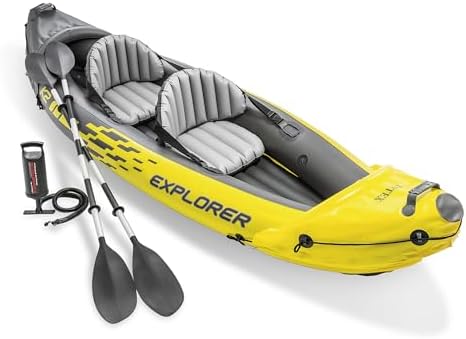
The Explorer K2 is the boat I hand to friends who have never inflated anything in their lives. Two seats, two 86-inch aluminum oars, and a high-output pump in the box, which means you are not hunting for a third purchase before you can get on the water.
Timed setup, solo, with the included pump: the main chambers come up fast, and the seats eat the most time because you are threading backrest straps while the hull is still soft. I have run this one three times on the same ramp and the pattern holds. The SuperStrong PVC hull takes 3 PSI in the main chambers, and the floor is not drop-stitch, so you are paddling a soft-bottomed boat. That is fine on flat water. It is not fine if you want to stand up and cast.
The weight rating is 400 lb. I weigh about 200 and I have paddled it with a second adult and a cooler, and here is what I tell everyone: treat that 400 as a lab number and plan on roughly 250 to 300 lb of real people and gear before the hull starts dragging. That is when the skeg matters. There is a removable skeg on the stern, and with it deployed in a light chop the K2 holds a line well enough that you are not correcting every stroke. Pull the skeg and it wanders.
The floor is the compromise. Soft floor, wet feet, and a slower hull than anything with a stiff floor. For a calm lake or a lazy spring run with a kid in the front seat, that trade is worth it.
Best Budget: INTEX Challenger
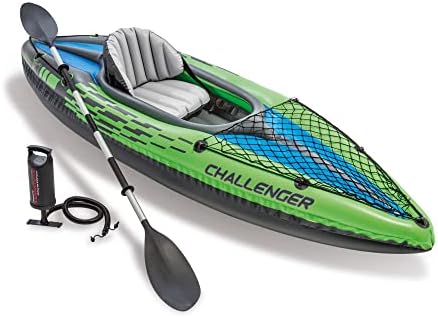
The Challenger is the cheapest way onto the water that I will actually recommend, and I want to be careful with that word. It is a solo boat with one adjustable seat and backrest, an 86-inch paddle, a high-output pump, a removable skeg, and a cargo net. Everything you need is in the box.
Setup is quick. The main body is a single-chamber design, which is why it pumps up in a couple of minutes with a hand pump, and also why I will never take it anywhere I cannot swim to shore. One puncture in a single-chamber hull is a swim. That is the honest trade.
It tracks about as well as you would expect from a light boat with a soft floor and a small skeg. In dead calm it goes where you point it. Add a crosswind and you are working. Add a real chop and you are working hard. I have had mine out on calm lakes and on a spring run with almost no current, and both were pleasant. I would not take it into open bay water or anywhere with a serious current line.
The material patches clean, which is the thing I care about most. I put a two-inch gash in a similar Intex hull years ago on a submerged branch, patched it with a bicycle tire repair kit, and that patch held three summers. This hull takes glue the same way. That is the standard I hold budget boats to, and the Challenger passes.
Best for Fishing: Pelican Sentinel 100X Angler
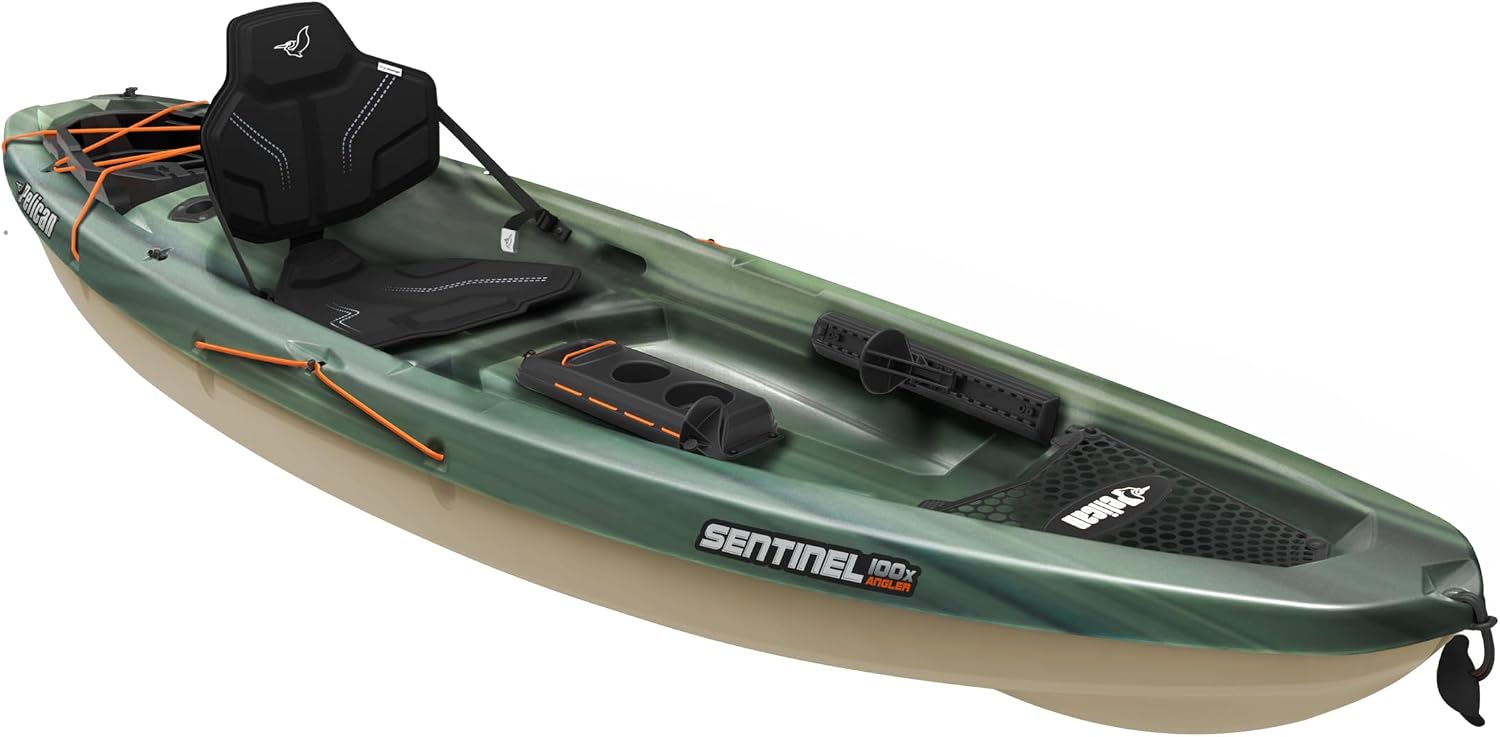
This one is not an inflatable, and I am including it because the question I get most often is not which inflatable, it is whether to buy an inflatable at all. The Sentinel 100X is a lightweight sit-on-top angler with the Ergolounge seating system, and it is the boat I grab when I want to fish instead of paddle.
Setup is the shortest of the three: unstrap it, drag it, go. No pump, no PSI, no waiting on a chamber to firm up. That alone changes how often you actually use the thing. The seat is the part people underestimate. The Ergolounge backrest is the most comfortable factory seat I have used in this bracket, and a comfortable seat is the difference between four hours on the water and two.
It is a sit-on-top, so it is heavier and bulkier to store than any inflatable, and it will not fold into a bag. If you live in an apartment or drive a sedan, that is a real problem. If you have a truck bed or a garage wall, it is not.
The hull tracks straight in a light chop, which is exactly where the two inflatables in this guide struggle. It is stable enough to stand and cast, and the open deck leaves room for a crate and a rod holder setup. For fishing, this is the one I would buy.
How I tested
Every boat got the same treatment. Same hand pump, same ramp, stopwatch, three timed inflations. I noted how long the hull took, how long the seats took, and where the pump hose kept popping off.
Then I paddled each one on the same three-mile spring run, same paddler, same current, and watched the tracking. I counted correction strokes in a headwind and noted every time a hull pushed sideways in a crosswind.
Then the part that matters more than any spec sheet: how the hull material behaves when it fails. Not with a knife on a showroom floor, but by looking at how the seams are built and how the material takes a patch. Every inflatable leaks eventually. The question is whether the leak is a five-minute fix or the end of the boat.
Finally, I packed each one wet, in the rain, and timed the whole job from water to truck. That number decides whether you go out on a Sunday morning or stay home.
Analysis and test results
Setup time separated these three immediately. The Challenger is the fastest inflatable to get on the water, and the Explorer K2 is close behind, but the K2 loses time on the seats. Both lose to the Sentinel 100X, which needs no inflation at all.
Floor stiffness is where the two inflatables fall down. Neither has a drop-stitch floor, so neither gets board-stiff at pressure. Drop-stitch is the difference between paddling and floating, and if you want that in an inflatable you are shopping in a different price bracket. What you get here is a soft floor that is comfortable, forgiving, and slow.
Tracking is the other gap. Both Intex boats lean on a small removable skeg to hold a line, and both wander without it. In a light chop the Sentinel 100X tracks noticeably straighter with no skeg at all. If your water is windy, that is worth more than the storage advantage of an inflatable.
Weight ratings deserve a note. The Explorer K2 carries a 400 lb rating. With a real 200 lb paddler and a cooler, it is fine on flat water and sluggish in wind. Ratings are measured on a scale, not on a lake with chop.
Patchability is where the Intex hulls win. Soft PVC takes glue well and patches flat. Over five years of ownership that matters more than anything else in this article.
The setup and spec reference table
| Boat | Type | Setup | Floor and tracking | Best for |
|---|---|---|---|---|
 Visit on Amazon → Intex 68307EP Explorer K2 |
Two-person inflatable | Pump and oars included, seats take the longest | Soft PVC floor, holds a line with the skeg deployed | Calm lakes and tandem days |
 Visit on Amazon → INTEX Challenger |
Solo inflatable | Fastest of the inflatables to pump up | Soft PVC floor, wanders once the wind picks up | Budget calm-water paddling |
 Visit on Amazon → Pelican Sentinel 100X |
Sit-on-top angler | No inflation, unstrap and launch | Molded hull, straight in a light chop | Fishing and windy water |
The table is the short version of everything above. If you only remember one row, remember the setup column, because that is the number that decides whether the boat gets used.
Should you buy the Intex Explorer K2?
Yes, if you want a two-person boat that arrives with the pump and the oars and you paddle calm water. It is the boat I lend to beginners. It sets up in a reasonable time with the included pump, it carries two adults on flat water, and the PVC hull patches clean.
Do not expect a stiff floor or sharp tracking in wind, and do not take the 400 lb rating literally with a full cooler aboard. Within those limits, it is the best all-around pick here.
Should you buy the INTEX Challenger?
Yes, if budget is the deciding factor and your water is calm. It is light, it is the quickest inflatable here to pump up, and the hull takes a patch. That combination is hard to beat at the bottom of the market.
It is also a single-chamber hull with soft-floor tracking, so keep it on lakes and slow spring runs and stay within swimming distance of shore. If you want to fish or paddle open water, look at the other two.
Should you buy the Pelican Sentinel 100X?
Yes, if you fish and you have somewhere to store a hard boat. No pump, no setup wait, a seat you can sit in for four hours, and tracking that holds its line in a light chop.
It costs more than either inflatable and it will not fold into a duffel. If storage and transport are your limits, buy one of the Intex boats and accept the soft floor. If they are not, the Sentinel is the boat you will actually use.