An inflatable tandem kayak is the cheapest way to get two people on the water without a roof rack, a trailer, or a sixty-pound hardshell you have to lift over your head in a parking lot. It is also the easiest way to waste a Saturday morning. I have stood on enough Florida boat ramps at 7 a.m. to know the pattern: one person pumping, one person holding the bag, and a third person asking whether the boat is supposed to look like that.
The difference between a tandem you use every weekend and a tandem that lives in the garage comes down to three things, and none of them are the color. Floor stiffness, setup time, and how the hull behaves when you finally have to patch it.
Why you should trust me
I am Sam. I live in Tampa and I have paddled Florida springs and mangrove creeks every weekend for nine years. Before that I worked as a charter fishing deckhand, which is where I learned to read current lines and wind instead of fighting them. I own two inflatables, a drop-stitch sea-kayak style boat and a cheap recreational tube. The cheap one has been patched twice, once with a bicycle tire repair kit after a submerged branch tore a two-inch gash in the hull. That patch is still holding three summers later, and it taught me more about hull material and glue than any spec sheet.
That set the standard I hold every boat to. I keep a hand pump, a patch kit, and a stopwatch in the truck. Setup time is the spec that matters most, because a fifteen-minute pump session kills the trip before it starts.
What actually matters in a two-person inflatable
Floor construction. "Drop-stitch" gets thrown around like a magic word. It is not. Drop-stitch means thousands of polyester threads link the floor's two layers so it inflates board-stiff instead of balloon-soft. The stiffness is what you are paying for, not the label. A soft floor with two adults aboard sags in the middle, and a sagging floor sends every stroke sideways instead of forward.
Inflation pressure. PSI is the number you read on the pump gauge. Three PSI is a puddle. A drop-stitch floor pushed to 10 or 12 PSI is a board. Side chambers run much lower, usually 2 to 3 PSI, and they should feel firm but not drum-tight. Overinflating on a hot dock is how you find the seam that was going to fail anyway. Inflate in the shade, then top off at the water.
Tracking, rocker, and fins. Tracking is how straight the kayak holds its line without constant correction. Bad tracking means zigzag, and zigzag means tired arms. Rocker is the curve from bow to stern: more rocker turns easier and rides waves, less rocker tracks straighter and paddles faster. On a wide tandem, a removable fin or skeg is the cheapest fix for a hull that wanders.
Weight ratings, honestly. A rating is a lab number measured on flat water. A 500-pound rating with two adults and a cooler means the hull sits low, and a low hull plows. If you and your partner plus gear land within 60 percent of the rating, you are asking a lot of the boat, especially on a hot afternoon when the air inside expands and the tubes soften. Weigh your gear once. A full cooler, two paddles, and a dry bag add up faster than people expect.
The two tandems worth a hard look
Both of these are two-person boats with a wide, stable hull and a price that puts them in reach of a first-time buyer. They are not the same boat, and the choice comes down to how you plan to use it.
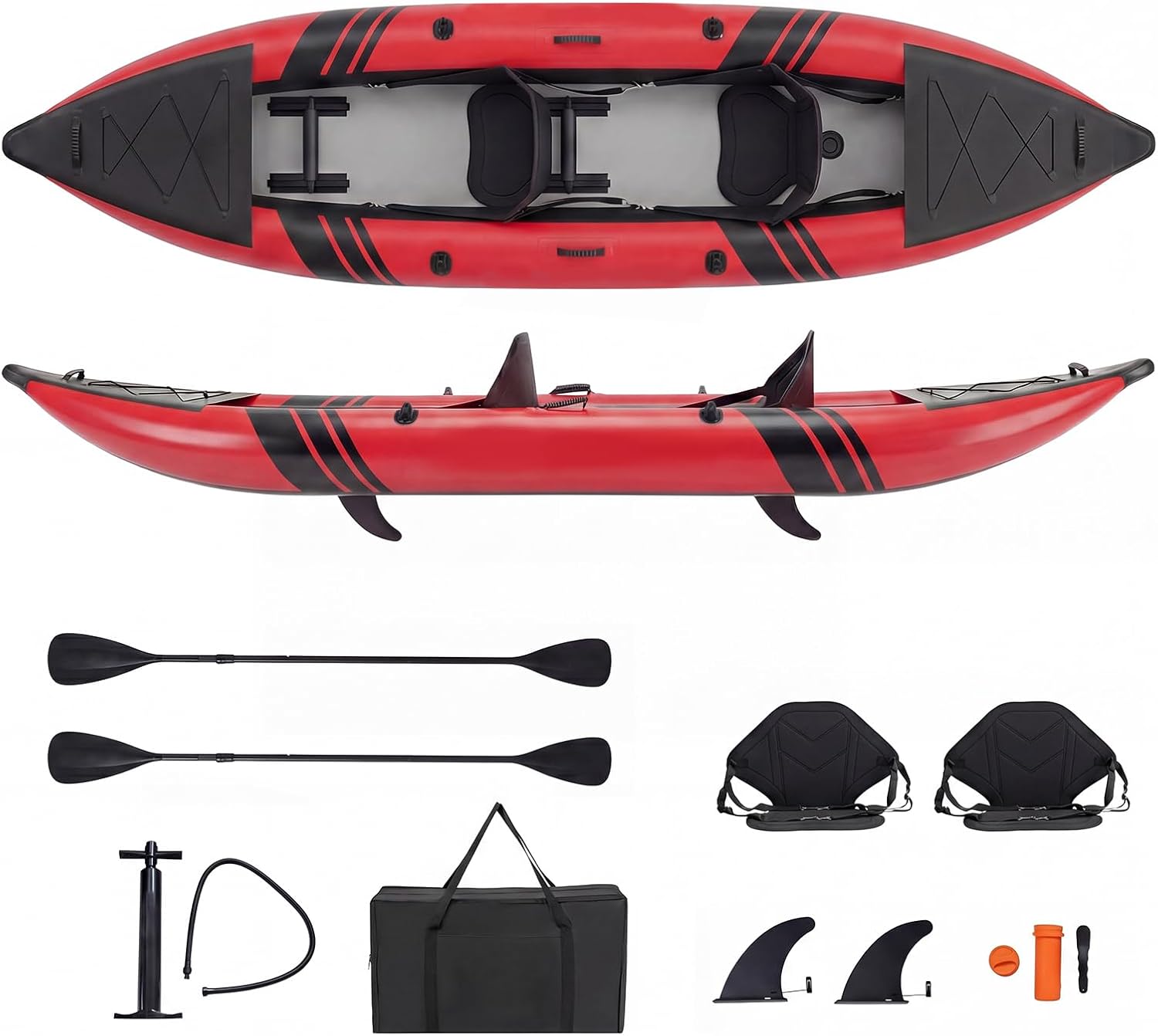
Best for two adults plus gear: GYMAX Inflatable Kayak, 12.5Ft 507lbs Tandem Kayak with 2 Aluminum Paddles, 2 Padded Seats, Footrests, 2 Fins, Hand Pump, Carry Bag & Repair Kit, 2 Person Fishing Touring Kayak for Adults
 Visit on Amazon →
The 12.5-foot length is the detail that matters. Longer hulls track better than short ones, and on a tandem that difference shows up the moment you stop correcting your partner's strokes. The 507-pound rating leaves two full-size adults room for gear, though treat that number as a flat-water ceiling rather than a promise for a windy bay. It ships as a complete kit: two aluminum paddles, two padded seats, footrests, two fins, a hand pump, a carry bag, and a repair kit.
Read that list against the checklist above. Footrests mean the front paddler can brace and put real power into a stroke instead of sliding around. Two fins mean there is a tracking aid you can pull for shallow water. The repair kit is the one item I would inspect before the first trip, because patch kits with glue that has already dried out in the box are a common complaint, and a kit you cannot use is worse than no kit at all, since you packed it and stopped worrying.
The trade-offs are the usual ones for a boat this size. It is a lot of kayak to inflate, and the aluminum paddles that come in a bundle like this are serviceable rather than good. Plan on replacing them if you paddle more than a few times a season.
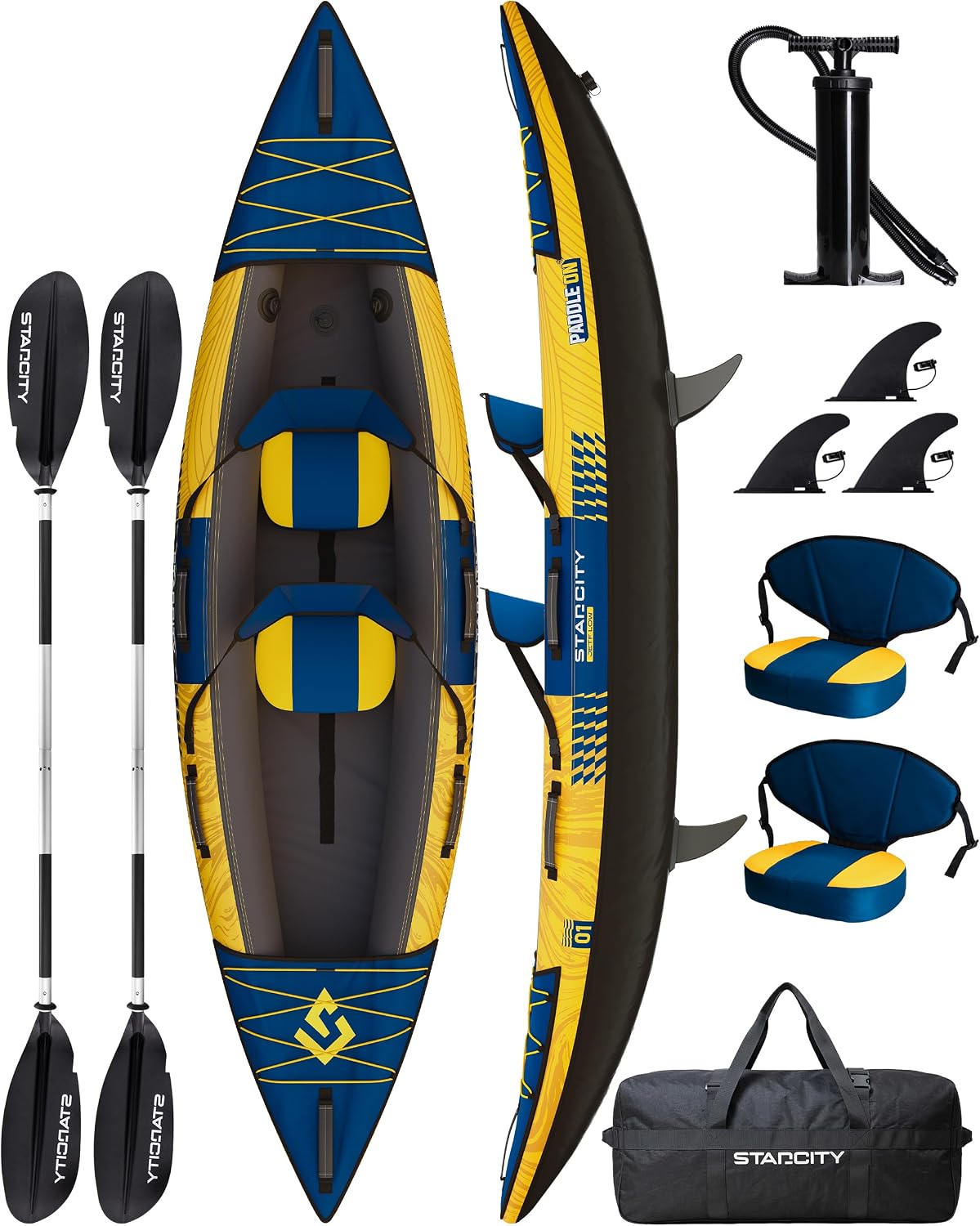
Best budget tandem: Starcity Kayak Inflatable Tandem Wide Stable Touring Fishing Design 600 Pound Capacity 12" 2"*36"*13" for Lake River Recreational Paddling Families Beginners W/Adjustable Seat Storage Compartment
 Visit on Amazon →
This one leans hard into stability and family use, and the 600-pound capacity is the headline. Wide and stable is the right call for beginners, because the first thing a new paddler does is lean, and a narrow hull punishes leaning. The adjustable seat is a real feature, not filler: seat position changes your reach and your trim, and being able to slide it forward or back is how you balance the boat when one paddler weighs considerably more than the other. The storage compartment keeps a dry bag or a small tackle box out of the footwell.
Understand what you are buying, though. A wide hull is stable and slow. It will not track like the longer boat above, and into a headwind you will work for every yard. If your plan is calm lakes, slow rivers, and recreational paddling with kids or a dog, that is the correct trade. If your plan is covering distance on open water, it is not.
How to set up an inflatable tandem kayak
Step one: lay it out flat. Unroll the boat on grass or a towel, not on asphalt or gravel. Sun-heated pavement is rough on hull material, and a sharp shell or a piece of glass under the boat is how you start a trip with a leak.
Step two: inflate the floor first. The floor sets the shape. Bring it to the pressure printed on the boat or in the manual, usually 8 to 12 PSI on a drop-stitch floor. Watch the gauge instead of guessing by feel.
Step three: inflate the side chambers. These run lower, typically 2 to 3 PSI. Firm, not hard. If you are launching in the morning and leaving the boat in the sun all day, leave a little room for expansion and recheck at lunch.
Step four: install the seats. Clip them in, then sit in the boat on land and set the footrests. This is the step everyone skips and regrets two miles out.
Step five: attach fins or skeg last. They catch on everything during setup. Put them on at the water's edge.
Step six: trim the load. Heavier paddler in the back, gear centered and low. A nose-heavy boat weathervanes in the wind no matter how good the hull is.
Step seven: dry it before you bag it. Deflate, wipe the hull down, and let it dry in the shade before it goes in the carry bag. A boat packed wet is a boat that smells like a locker room by August.
How to patch a pinhole, and how to patch a gash
Small punctures and long tears are different repairs, and treating them the same is how a patch fails.
For a pinhole or a slow leak, find it first. Inflate the boat, spray soapy water along the seams and the floor, and watch for bubbles. Mark the spot, deflate, and clean the area with alcohol. Let it dry completely.
Cut the patch round or oval, never square, because corners peel. Make it at least an inch larger than the damage on every side. Glue both the patch and the hull, let the glue get tacky per the instructions, then press the patch down and roll from the center out to push bubbles to the edge. Weight it and leave it alone for a full day. That cure time is not optional.
For a gash, it is the same procedure with more surface area. If the cut goes through a seam or a baffle, stop and call the manufacturer. A field patch on a seam holds long enough to get you back to the ramp, not long enough to trust. That is exactly why I keep a bicycle tire patch kit in the truck. It is not the right tool, but it is a tool, and it held a two-inch gash on my cheap boat for three summers.
How to make an inflatable track straight in a chop
Three adjustments, in order of effort.
Move weight forward. A stern-heavy tandem drags its tail and hunts left and right. Slide the front seat forward and put the cooler up front.
Deploy a fin or skeg. If the boat came with one, use it on open water. It is the biggest tracking improvement you can make for free.
Shorten your stroke. Long sweeping strokes in a chop push the bow around. Shorter, higher-cadence strokes with a firm catch keep the boat running straight.
If it still wanders after all three, the hull has more rocker than you want for flat water, and no accessory fixes that.
Common questions
How long should setup take? With a real hand pump and a drop-stitch floor, budget eight to twelve minutes from bag to water for a tandem. Add five if you are alone in wind.
Can one person paddle a tandem alone? Yes, from the rear seat, and it will sit high in the bow. Move gear forward to trim it.
Do I need a pump upgrade? The hand pump in the box works. A double-action pump with a gauge cuts the time roughly in half, and the gauge is the part that matters, because guessing at PSI is how floors go soft and seams get stressed.
Will a wide boat be slow? Yes, and that is the point. Stability and speed trade against each other. Pick the hull that matches the water you actually paddle.
The bottom line
Two adults, gear, and a full day on the water comes down to the floor under you. A stiff floor and a tracking aid turn a soft, wandering tube into a boat you will use. Choose the longer hull if you want to cover distance, choose the wider one if you want stability for beginners and kids, then spend twenty minutes at home learning how it inflates, how it trims, and how it patches before you are doing it in the rain at a boat ramp.
Everything else is color.