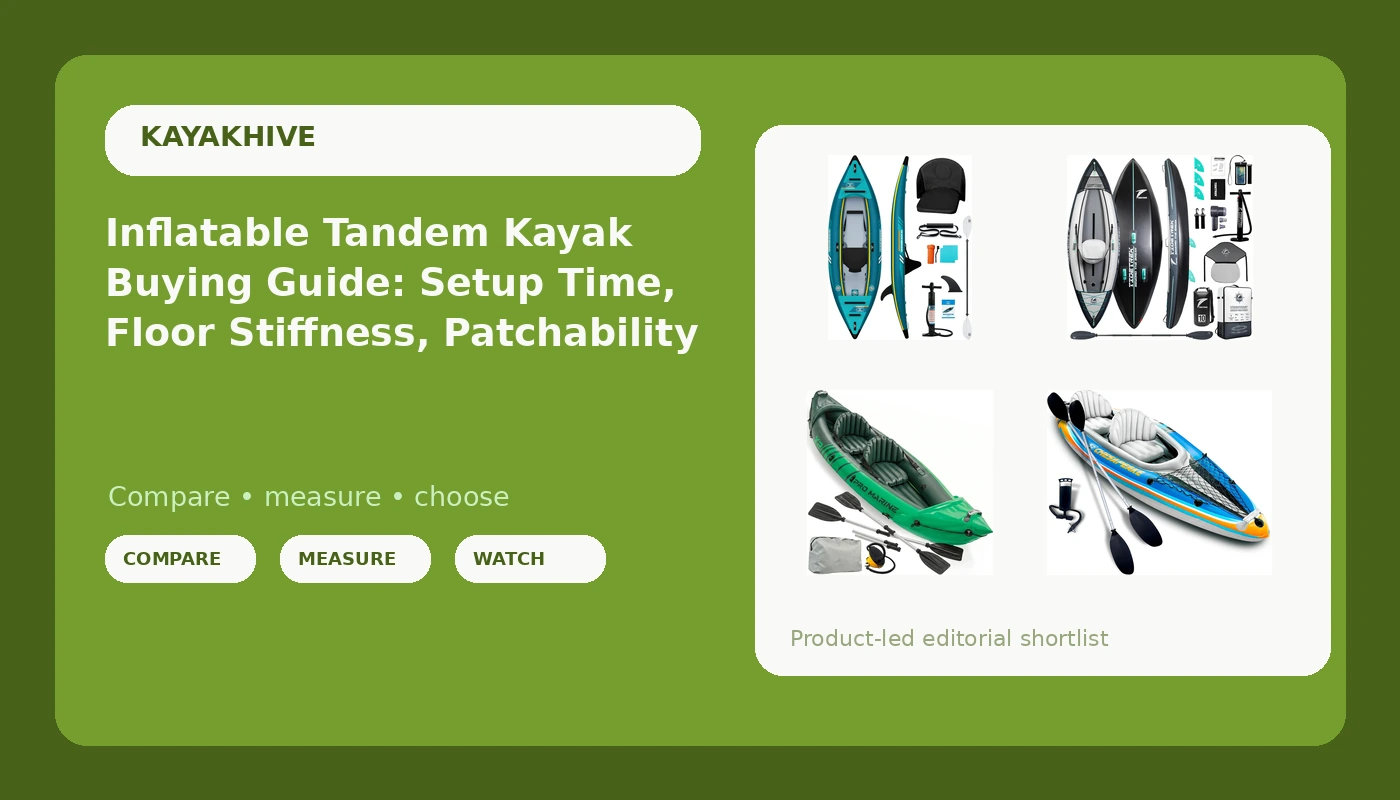
An inflatable tandem kayak solves a problem a hardshell cannot. It lives in a closet, rides in a sedan trunk, and goes from bag to water without a roof rack or a second person to help load it. The catch is that the category spans everything from a two-person pool toy to a boat with a stiff drop-stitch floor that paddles close to a rigid hull, and the listings use nearly identical language to describe both. This guide walks through four currently listed inflatable tandem kayaks, what each one actually includes, and the handful of specifications that decide whether you will still want to paddle it after the first season.
Related: How to Patch an Inflatable Kayak So the Repair Holds →
Quick answer
For most paddlers the decision comes down to three things: how stiff the floor gets at pressure, what ships in the box, and whether the hull carries the identification number your state may ask for. If you want one boat that covers solo and tandem days with a full accessory kit, the touring kayak with the waterproof seat is the place to start. If a sit-in cockpit is what you are after, read the OCEANBROAD listing closely. If you want a complete package, the Brone set includes seats, paddles, a pump, and a bag, while the Sunlite Sports tandem adds a canopy and aluminum oars. None of these is a whitewater boat, and none replaces a hardshell for exposed coastal water.
Four useful options
| Model | Best fit | What stands out |
|---|---|---|
| Inflatable Touring Kayak 1-Person & 2-Person with Waterproof Seat & Full Accessory Kit | Paddlers who want one boat for solo and tandem days | Configures for one or two paddlers and includes a waterproof seat and full accessory kit |
| Brone Inflatable Tandem Kayak Set with Seats, Paddles, Pump, and Bag | First-time buyers who want everything in one purchase | Seats, paddles, pump, and bag are all part of the set |
| OCEANBROAD Inflatable Sit-in Kayak(NO HIN), 1 Person/2 Person Touring Kayak | Paddlers who prefer a sit-in cockpit | Sit-in touring design that configures for one or two paddlers |
| Sunlite Sports Inflatable Kayak 2 Person with Canopy | Paddlers who want shade and included oars | Attached canopy, aluminum oars, air pump, and carry bag, listed at a 400 LB capacity |
The touring convertible: Inflatable Touring Kayak 1-Person & 2-Person with Waterproof Seat & Full Accessory Kit, Lightweight Recreational Kayak for Lake, River & Fishing
This is the listing to read first if you do not yet know whether you will paddle alone or with a partner. A boat that converts between one and two paddlers sounds like a compromise, and in some ways it is. A hull long enough to carry two adults will feel long and light in the bow when you paddle it solo, and a hull short enough to trim well solo will sit low with two aboard. What the convertible layout buys you is one bag, one pump, and one set of straps instead of two boats. The waterproof seat and the accessory kit matter more than they look on paper, because a seat and a pump bought separately are the two items people most often forget on the way out the door. Check the floor construction before you commit. The seat and the kit are conveniences. The floor is the boat.
The complete starter set: Brone Inflatable Tandem Kayak Set with Seats, Paddles, Pump, and Bag
A tandem set that arrives with seats, paddles, a pump, and a bag removes the most common first-trip problem, which is standing at the ramp with a boat and no way to inflate it. Sets like this are aimed at recreational paddling on calm water, and that is where they make sense. The trade-off is that included paddles and pumps are usually the minimum needed to get on the water rather than the gear you would choose for a long day. Plan on a spare hand pump or a second paddle as a later upgrade. Before you commit, look at how the seats attach. A seat that slides or works loose is the first thing that will annoy you on a two-hour paddle, and it is the cheapest thing to fix if you catch it before you buy.
The sit-in touring option: OCEANBROAD Inflatable Sit-in Kayak(NO HIN), 1 Person/2 Person Touring Kayak
Sit-in means your legs and lower body ride inside the hull rather than on top of a deck. That changes how the boat feels in wind and chop, and it changes how wet you get from spray coming over the bow. It also changes how you get back in if you swim, so a sit-in inflatable is best paired with a practiced re-entry and either a paddle float or a partner who knows the drill. The listing also notes that this hull carries no identification number. That matters in states that require registration for the watercraft they regulate, because a registration application typically asks for that number. Check the rules where you paddle before ordering. The one-or-two person layout puts this boat in the same convertible category as the touring kayak above, just with a different seating position.
The shaded tandem: Sunlite Sports Inflatable Kayak 2 Person with Canopy, Portable Inflatable Boat with Shed & Aluminum Oars, Lightweight Tandem Kayak with Air Pump & Carry Bag for Lakes & Rivers, 400 LB
The canopy is the distinguishing feature here, and it deserves an honest look. Shade on open water is a real comfort advantage on a summer afternoon, and it is why most people buy this style of boat in the first place. The trade-off is wind. Any fabric structure standing above the deck catches breeze, and on a hull that already sits high on the water, a canopy can push you around once the wind picks up. On a small lake or a slow river, that is a fair trade. On big open water, plan to leave the canopy at home on windy days and treat it as a feature for calm mornings. The aluminum oars, air pump, and carry bag round out the package.
Prices and availability may change. Product images, names, and retailer links are matched to verified listings. No current price, rating, stock status, or measured result is stated here without current evidence.
How floor construction and hull shape change the way a tandem paddles
Inflatable kayaks generally use one of two floor designs, and the difference between them is the single biggest factor in how the boat feels under way. The first is an inflated tube floor, which is soft, flexes under a paddler, and lets the hull bend slightly in chop. The second is a drop-stitch floor, where thousands of threads connect the top and bottom layers of the floor panel so it inflates into a stiff, flat platform instead of a balloon. That stiffness is what transfers the energy of your stroke into forward motion instead of into hull flex. A soft floor is not dangerous, but it is the reason a cheap inflatable feels like floating rather than paddling.
Pressure is the other half of the story. Side tubes and floor panels are inflated to different targets, and the floor is the one that matters most. A drop-stitch floor inflated properly feels firm underfoot and barely flexes when you press on it. Underinflated, the same boat will wallow and track poorly no matter how good the hull shape is.
Hull shape sets the rest. Rocker is the curve of the hull from bow to stern. More rocker turns easily and rides waves, but it paddles slower and wanders on flat water. Less rocker tracks straighter and covers distance with less effort, which is why touring shapes look long and flat. Tracking is simply how well the boat holds a line without constant corrections. A wide, flat-bottomed tandem sits on top of the water and gets pushed sideways by wind, and a small deployable skeg can fix a lot of that on calm water without buying a different boat.
Finally, count the air chambers. Multiple independent chambers mean a single puncture does not end your day. Ask how many chambers the hull has and where they are. Then look at the hull material and the seams, because that is what determines whether a puncture patches cleanly or spreads.
What is actually in the box, and what the numbers mean
Accessory kits are where listings differ most, and the details matter more than the headline. Seats, paddles, a pump, and a bag are the four items you need on day one, and every boat here includes at least some of them. A hand pump that comes in the box is usually serviceable but slow, and inflating a tandem hull to the correct pressure takes longer than the listing suggests. A 12-volt pump saves your arms but ties you to a vehicle, which is fine at a boat ramp and useless at a walk-in launch. If setup time is what decides whether you paddle, the pump is worth as much attention as the boat.
Capacity numbers deserve a margin. A 400 LB rating describes a hull in controlled conditions, and a hot afternoon with chop, current, and gear is not a controlled condition. Two adults plus cooler, dry bags, and fishing tackle add up faster than people expect. Whatever the rating says, leave room in it.
Registration is the specification almost nobody reads. Some states require registration for the watercraft they regulate, and a registration application typically asks for a hull identification number. A boat listed without one can still be fine where registration does not apply, but check your own state's rules before ordering rather than after.
Then there is drying. Mildew, not punctures, is what kills most inflatable kayaks. A hull folded away wet and left in a hot garage will grow a smell you cannot get out, and no warranty covers that.
- Measure your storage space and your trunk before you shop, because packed size matters more than inflated size.
- Decide whether you need a solo boat, a tandem, or a convertible that does both.
- Check whether the floor is drop-stitch or an inflated tube, and treat the floor as the main performance spec.
- Count the air chambers and read the seam and fabric description for patchability.
- Confirm what is included and what you must buy separately, and check registration rules for the water you paddle.
Practical guidance before you order
- Buy a pump you can live with, and keep a patch kit with fresh glue stored in the bag.
- Inflate to the pressure marked on the boat, then check it again once the hull has cooled in the water.
- Practice getting back into the boat close to shore, before you need to do it for real.
- Dry the hull and the bag completely, then store the boat loosely folded rather than compressed in a hot car.
- Match the boat to the water you actually paddle. Calm lakes and slow rivers are what these hulls are built for.
Which option should you choose?
Choose the Inflatable Touring Kayak 1-Person & 2-Person with Waterproof Seat & Full Accessory Kit when you want one boat that covers solo and tandem days and you would rather have the seat and accessory kit included from the start. Choose the Brone Inflatable Tandem Kayak Set with Seats, Paddles, Pump, and Bag when you want a complete tandem package in a single purchase and you are paddling calm water. Choose the OCEANBROAD Inflatable Sit-in Kayak(NO HIN), 1 Person/2 Person Touring Kayak when a sit-in cockpit and a touring layout suit you, and you have confirmed the registration rules that apply where you paddle. Choose the Sunlite Sports Inflatable Kayak 2 Person with Canopy when shade matters and your water is a small lake or slow river where a canopy will not act like a sail.
Every detail above comes from the product listings themselves. Floor construction, chamber count, packed size, and seam type are the specs that decide how a boat performs, and they are not always stated clearly. Where a listing is silent on a detail, treat it as unknown rather than assuming the best case.
The bottom line
An inflatable tandem kayak is a storage and transport solution first and a paddling platform second, and these four boats cover the range from a complete starter set to a convertible touring hull and a shaded tandem. Read the floor specification before anything else, count what is actually in the box, and check the registration rules for your water. Then pick the layout that matches the paddling you really do, because the boat that gets used is the one that was quick to inflate, easy to carry, and simple to patch when the inevitable puncture finally shows up.