The argument between inflatable kayaks vs sit-on-top kayaks usually starts in a garage and ends on the water. If you have a spare wall, a roof rack, and a launch ramp ten minutes from the house, a rigid sit-on-top is a simple, honest boat. If you live in an apartment, drive a sedan, or paddle water you reach through a mangrove tunnel, an inflatable is the only design that gets you there at all.
The problem is that most shoppers compare these two styles on the wrong spec. They compare marketing photos and sticker numbers instead of asking three questions: how long does this boat take to become paddle-ready, how straight does it hold a line in a light chop, and what happens the first time the hull meets a submerged branch. Those three answers decide more trips than any color option.
Related: How to Patch an Inflatable Kayak So It Actually Holds →
Quick answer
Neither style wins outright, because they solve different problems. Inflatables earn their place when storage and transport are the binding constraints: the boat packs into a bag, travels in a trunk, and can be carried to water no trailer can reach. Sit-on-tops earn their place when setup time, hull rigidity, and tracking matter most: there is no pump, no pressure target to hit, and nothing to patch before you launch.
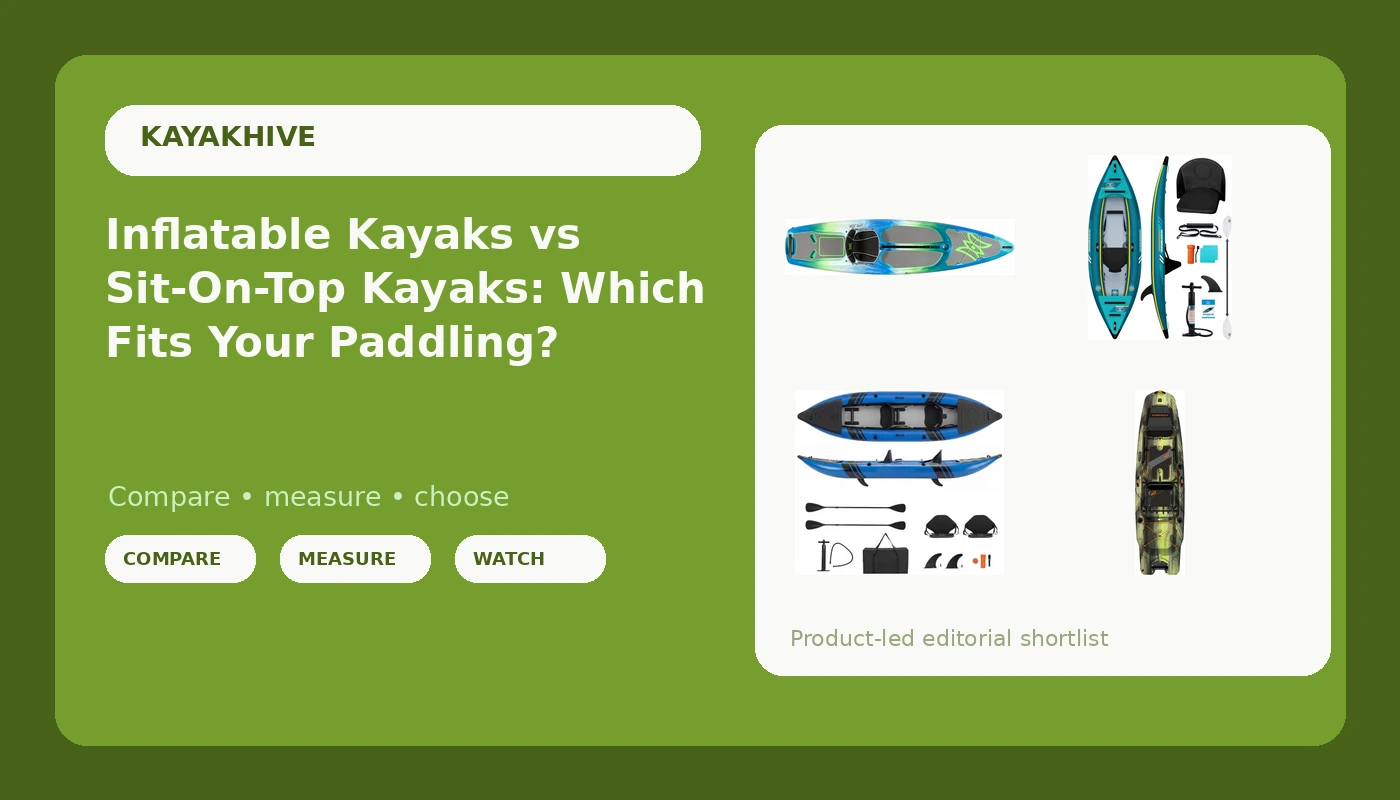
The four models below sit at four different points on that line. Two are rigid sit-on-tops, one built for standing as well as sitting, one aimed at anglers. Two are inflatables, one a sit-in touring shape and one a tandem package that arrives with most of the accessories already in the box.
4 useful options
| Model | Best fit | What stands out |
|---|---|---|
| Perception Hi Life | One hull for seated paddling and standing | Hybrid sit-on-top and stand up paddle board design |
| Pelican Catch Mode 110 Kayak | Paddlers who want a rigid boat ready off the rack | Sit-on-top hull from Pelican's Catch series |
| OCEANBROAD Inflatable Sit-in Kayak | Solo touring that can convert to two paddlers | Inflatable sit-in deck in a 1-person or 2-person layout |
| GYMAX Inflatable Kayak | Two paddlers who want the full kit in one box | 12.5 ft tandem package with paddles, seats, pump, bag, and repair kit |
Hybrid pick: Perception Hi Life
Hybrid hulls trade specialization for range. A boat stable enough to stand on is typically wider and flatter than a touring kayak, which costs some glide and rewards you with stability. Standing is also a flat-water skill: wind, boat wakes, and chop make the standing position less useful than the seat on most real days. The bigger practical cost is logistics. This is a rigid hull, so it needs a rack, a wall, or a garage bay, and it cannot go anywhere a packed bag can go.
Angler sit-on-top: Pelican Catch Mode 110 Kayak
The appeal of a rigid sit-on-top is that the setup step does not exist. It comes off the rack and goes in the water. Rigid hulls do not deflate overnight, do not lose pressure in a hot car, and do not need a patch kit in the dry bag. What they do need is a way to travel and a place to live. Measure your rack, your hatch, and your storage wall before you fall in love with a hull, because a boat that is inconvenient to move becomes a boat that stays home.
Inflatable touring: OCEANBROAD Inflatable Sit-in Kayak
A sit-in inflatable behaves differently from the sit-on-top inflatables most people picture. Sitting inside the hull changes how wind and spray reach you, and it changes how much water can collect around you if the cockpit is not draining well. That makes the deck design and any spray protection worth checking closely. The no HIN note matters too. A HIN is a hull identification number, and some states require one to register or title a paddlecraft. If your state registers kayaks, confirm that requirement before you order, not after the box arrives.
Tandem inflatable kit: GYMAX Inflatable Kayak
Tandem packages are where inflatables make their strongest case, because the accessories are the hidden cost of any kayak. A boat that includes paddles, seats, a pump, and a repair kit removes four separate purchases and the guessing that comes with them. Treat the 507 lb figure as a manufacturer rating, though. Ratings describe a maximum, and a maximum is not a working load. A 200 lb paddler plus a cooler, a dry bag, and a dog is a very different test than a number printed on a box, and hull behavior on a hot afternoon is different again. Load the boat lighter than the ceiling and keep gear low and centered.
Prices and availability may change. Product images, names, and retailer links are matched to verified listings. No current price, rating, stock status, or measured result is stated here without current evidence.
What the spec sheet does not tell you
Pressure is the number that decides how an inflatable feels, and it is the number most listings bury. Low-pressure inflatables, the kind pumped up like a pool float, sit on the water rather than in it. Drop-stitch construction changes that: thousands of internal threads link the two layers of the floor so the panel inflates board-stiff instead of balloon-soft. Drop-stitch is not a magic word, though. The floor stiffness is what you are actually paying for, and a stiff floor is what lets you paddle instead of float. If a listing does not tell you the recommended pressure, that is a gap worth noticing.
The second thing spec sheets skip is what happens after the first puncture. Every inflatable leaks eventually; the question is how easy it is to patch. A clean puncture in a decent hull can be repaired with a patch and a fresh tube of glue and can hold for years. A cheap hull can tear along a seam and spread. Two habits protect you here: confirm the repair kit includes glue that is still liquid, since dried-out glue in a sealed box is a common disappointment, and keep a spare patch and a small tube of adhesive in the dry bag rather than in a garage drawer.
Tracking is the third gap. Tracking is how straight a kayak holds its line without constant correction, and bad tracking means zigzag, and zigzag means tired arms. Hull shape drives it. More rocker, meaning more curve from bow to stern, turns easily and rides waves but wanders. Less rocker tracks straighter and paddles faster. On an inflatable, a skeg or fin does a lot of the correction work for you, which is why the included fins on a tandem package are not a throwaway detail.
Matching the hull to your water and your week
Water type and storage space decide this faster than any review. Calm lakes and slow rivers forgive almost any hull. Windy open water and tidal creeks punish bad tracking. Long carries through mangroves or over a levee punish weight. A roof rack and a garage reward a rigid hull; a third-floor apartment and a compact car reward a bag.
- Time the setup you are actually buying. Inflating to the correct pressure with a hand pump is physical work, and a long pump session is the most common reason an inflatable stays in the bag.
- Confirm the floor construction and the recommended pressure before you compare anything else, because that combination sets stiffness, which sets comfort.
- Ask what the repair kit contains and whether the hull material takes a patch cleanly, then keep a spare patch and glue on the boat.
- Weigh the boat and its bag against the carry you will really make, including the walk from parking to water.
- Check local registration rules, including any HIN requirement, before ordering rather than after.
Practical guidance before you buy
- Budget for the accessories, not just the hull. Paddles, seats, a pump, and a repair kit are separate purchases unless the package includes them.
- Buy a pump you will actually use. A hand pump with a pressure gauge beats a faster pump that leaves you guessing.
- Store an inflatable clean and dry and slightly deflated, since heat expands air and a fully inflated boat in a hot car is asking for a seam problem.
- Choose the seat before the color. On a long paddle, seat support matters more than graphics, and a padded seat with a back is not the same as a molded foam pad.
- Test the boat in calm, shallow water on a light day first, so you learn its tracking and its stability before you add wind, current, or gear.
Which option should you choose?
Choose the Perception Hi Life when you want one hull that covers both seated paddling and standing, and you have the rack and the storage to keep a rigid boat. Choose the Pelican Catch Mode 110 Kayak when you want a rigid sit-on-top with an open deck for gear and fishing, and you would rather skip the inflation step entirely. Choose the OCEANBROAD Inflatable Sit-in Kayak when you need the boat to pack down, you prefer sitting inside the hull, and you may want to add a second paddler later. Choose the GYMAX Inflatable Kayak when two people are paddling together and you want the paddles, seats, pump, bag, and repair kit handled in one purchase.
One caveat applies to all four. This comparison uses manufacturer and listing information, not a timed on-water trial of these specific hulls, so setup time, stiffness at pressure, and tracking on your local water are still things you have to verify for yourself. The specifications that matter most, floor construction, recommended pressure, capacity, and included accessories, are the ones worth confirming on the current listing before you commit.
The bottom line
Inflatable kayaks vs sit-on-top kayaks is not a contest with a winner; it is a match between a hull and a routine. If your constraints are storage, transport, and getting to water a rack cannot reach, an inflatable like the OCEANBROAD sit-in or the GYMAX tandem solves the problem that matters. If your constraints are setup time and a rigid hull you can trust in wind, a sit-on-top like the Pelican Catch Mode 110 or the hybrid Perception Hi Life removes the pump from your morning. Decide which constraint actually bites, then pick the boat that removes it.