Two paddlers in one hull sounds like half the work. It is not. A tandem fishing kayak setup doubles the number of decisions you make before you touch water: who sits where, who carries the tackle, how the load sits bow to stern, and what happens when one of you hooks a fish while the other one is still drifting down a mangrove creek.
I have paddled Florida springs and backcountry creeks most weekends for nine years, and I have watched more tandem crews come apart at the ramp than on the water. The boat is rarely the problem. The order of operations is.
This is the sequence I use: how to load a two-person boat so it tracks, how to launch it without one person standing in the mud holding the bow, and how to fish from it without turning every cast into a negotiation.
Why you should trust me
I am not a shop guy. I spent my twenties as a charter fishing deckhand out of Tampa, which is where I learned to read a current line instead of fighting it, and I have been paddling springs and mangrove creeks on weekends ever since.
I also own two inflatables, one drop-stitch sea-kayak style boat and one cheap recreational tube. I tore a two-inch gash in the cheap one on a submerged branch and patched it with a bicycle tire repair kit. That patch is still holding three summers later. It taught me more about hull material than any spec sheet ever has.
Every boat I get on, mine or someone else's, gets the same treatment: a stopwatch on the ramp, a hard look at how the load sits with a 200 pound paddler aboard, and a check of whether it holds a line in a light chop. Setup time and tracking are the two specs that decide whether a boat gets used or sits in the garage.
How I picked the two boats here
This is a how-to, not a shootout, so I am keeping it to two hulls that cover the two ways people actually paddle with a partner: a dedicated tandem for two anglers who go out together, and a smaller sit-on-top that works as a solo boat and an occasional two-person boat for a light pair.
Four questions decide everything for me:
- How long does it take to get from the truck to the water, honestly timed?
- Does the load sit level with real paddlers and real gear aboard?
- Does it hold a line without constant correction?
- If something goes wrong with the hull, how hard is it to fix?
On an inflatable, question four is a patch kit and a tube of glue. On a rotomolded hardshell, it is a plastic welder or a trip to a shop, which is a different kind of commitment. Neither answer is wrong. You just need to know which one you are signing up for.
The two boats in this setup
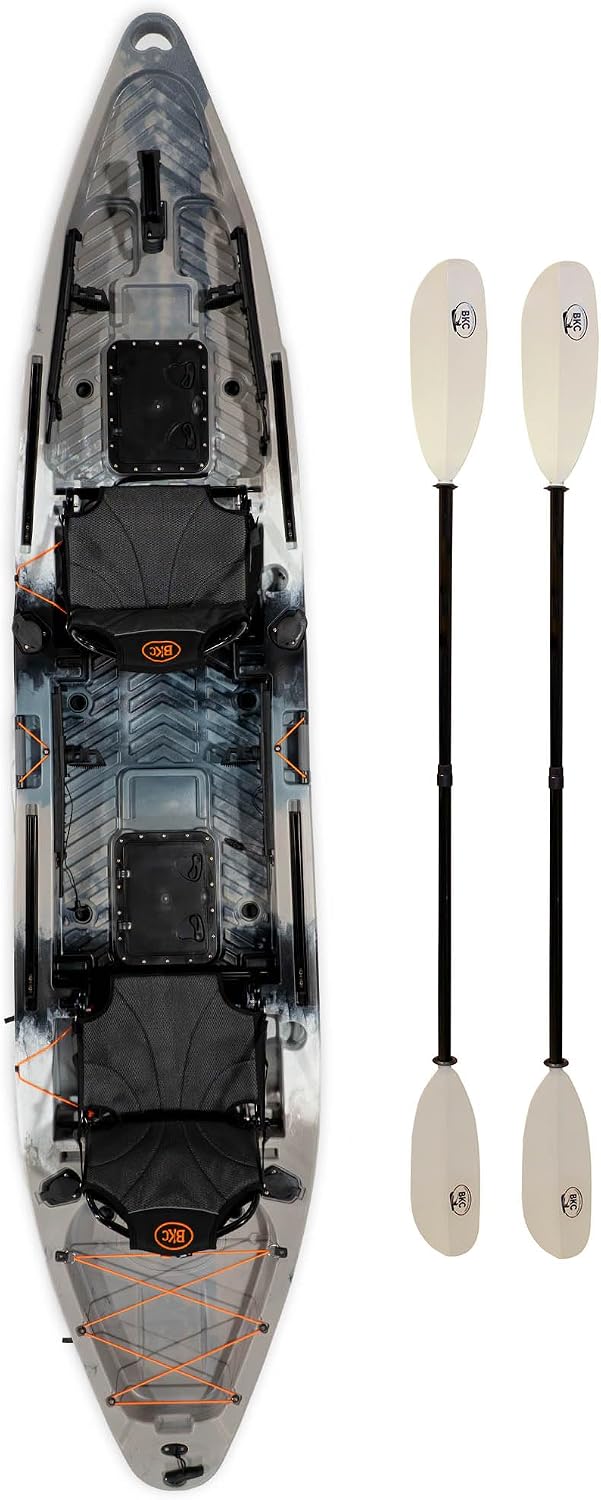
Tandem pick: BKC Brooklyn 13.0 Pro Tandem Fishing Kayak, 2 to 3 Person
 Visit on Amazon →
This is the boat I would point a pair of anglers at when they plan to fish together most trips. It is built for two to three people, and that matters more than people think: a boat with volume for three paddlers can carry two adults plus tackle, a cooler, and rods without sitting stern-down in the water. A boat sized for two adults and nothing else will not.
The length is the other thing. A longer hull tracks straighter and carries more glide, which is exactly what you want when one paddler stops to net a fish and the other keeps the boat moving. Short tandems spin. Long tandems hold a line.
Two caveats before you buy. First, a two-to-three person boat is a lot of hull for one person to paddle alone, especially into a headwind on open water. Second, rotomolded plastic is heavy, and heavy means a cart or a second set of hands at the ramp. Budget for that, because a tandem you cannot move by yourself is a tandem that only gets used when your partner is free.
Flaws but not dealbreakers: It is a big boat, and big boats demand storage space. If you haul it in a pickup bed, you will want a bed extender and a flag.
Best for pairs who fish together on bays, flats, and slow rivers and want one boat to do all of it.
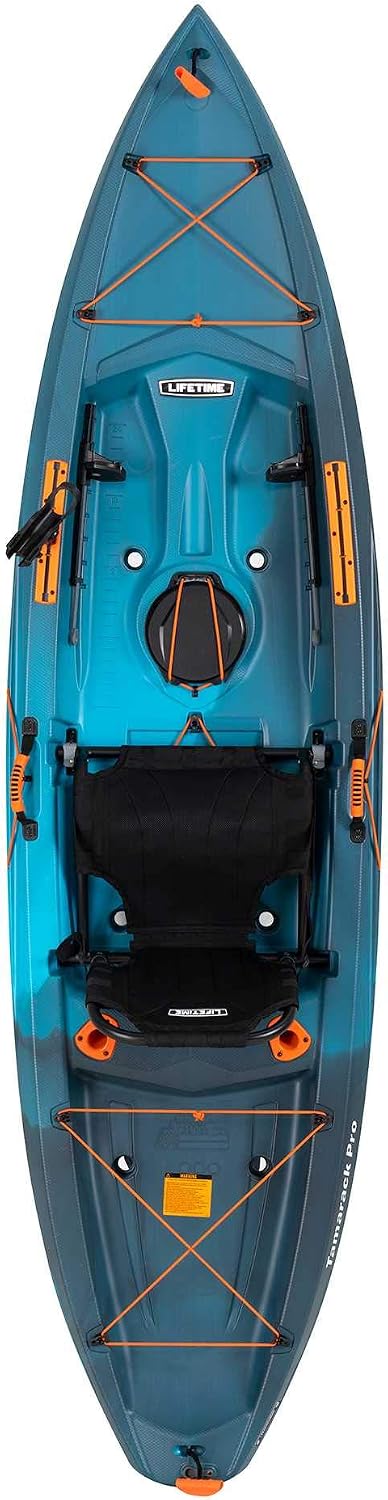
Solo and light-tandem pick: Lifetime Tamarack Pro 103 Sit-On-Top Kayak, Lightning Fusion, 10 ft. 3 in.
 Visit on Amazon →
Not everyone needs a tandem. If most of your trips are solo and you want a second seat for a kid, a friend, or a partner once a month, a 10 foot 3 inch sit-on-top is the smarter buy.
Sit-on-top means you are not bailing a cockpit, and you can slide off and back on in open water without flooding anything. For a beginner or a casual fishing partner, that is the single most valuable feature on the boat. It is also the boat I hand someone who has never paddled before, because falling out of it is a non-event.
The trade is speed and capacity. A 10 foot hull will not keep pace with a 13 foot tandem, and it will not carry two full fishing setups plus a cooler comfortably. Treat the second seat as occasional, not permanent.
Flaws but not dealbreakers: Short hulls weathercock in wind, meaning the bow gets pushed around the moment you stop paddling. If you fish open water, plan on a drift chute or an anchor trolley to hold your position.
Best for a solo angler who wants one hull that does double duty, and for anyone who wants a boat a beginner can handle on day one.
Rigging the boat: the order that matters
Rig on land, not on the water. Every minute you spend fiddling with a rod holder while floating is a minute the wind is pushing you into the mangroves.
Step one: settle the seating. Put the lighter paddler in the bow and the heavier paddler in the stern. A slightly bow-up trim keeps the bow from plowing and gives the stern paddler, who is doing the steering, the deepest bite in the water.
Step two: distribute weight low and centered. Coolers, tackle bags, and battery boxes go on the deck, not stacked on top of a seat. High weight is what makes a tandem feel tippy, and it is the number one reason a two-person boat feels unstable on flat water.
Step three: rig one rod holder per angler, plus one. Two anglers, three holders. The third one is where the rod goes when you are dealing with a fish, a tangle, or a sandwich.
Step four: anchor system before you launch. If you fish current or wind at all, an anchor trolley lets you point the bow into it and stay put. Clip it on land where you can see what you are doing.
Step five: leash the expensive stuff. Paddle, rods, net, and anything you would hate to lose. A tandem has two people's worth of gear in one hull, and one capsize empties the whole inventory.
Step six: dry bag and water. Two paddlers means two people's worth of hydration. Florida sun does not care that you launched at 7 a.m.
Weight ratings and the 200 pound reality check
Every kayak has a capacity number in the marketing copy. Do not build your plan around it.
A boat rated for 400 pounds is not pleasant at 400 pounds. Paddlers sit high, the hull sits low, water comes over the gunwales in a chop, and every wake feels like a near miss. The usable number is closer to two thirds of the sticker, and on a hot afternoon with a cooler aboard, less than that.
The way to check is simple. Load the boat exactly as you would on the water, in your driveway, and look at the waterline. If the scuppers are at or below the water, you are overloaded. If the hull still looks like it is sitting on its belly, you are fine.
Two other things that get skipped:
- Tracking. If the boat will not hold a line in a light chop, no amount of gear fixes it. A rudder or a skeg helps. A better paddle stroke does not.
- Reentry. A sit-on-top lets you slide back aboard. A sit-inside tandem with two people requires a wet exit, a rescue, and a plan. Practice it once in shallow water before you need it.
Launching and paddling a tandem without arguing
The classic tandem failure is two people paddling on opposite sides at the same time, which turns a straight line into a zigzag and burns twice the energy.
Pick a rhythm and stick to it. The most common one is simple: the bow paddler sets the pace on one side, the stern paddler matches on the other, and you switch together on a count. The stern paddler is the rudder. If the boat drifts left, the stern paddler sweeps on the right until it comes back.
When one of you hooks a fish, the other stops paddling and holds position. That is the whole rule. Fighting a fish while your partner keeps paddling drags the boat, the line, and the mood.
And if you fish current, point the bow upstream, anchor, and cast downstream. Read the current line instead of fighting it. The water does most of the work if you let it.
What this actually costs
The math that matters is not the sticker. It is cost per trip.
A tandem that gets used 30 times a season is cheap. A tandem that gets used four times because it is too heavy to load alone is expensive at any price, and that is the honest reason most two-person kayaks end up on a garage wall.
So price the whole kit, not the hull: the boat, two paddles, two PFDs, a cart, a roof rack or bed extender, an anchor trolley, and a repair kit for whatever the hull is made of. Check current Amazon price on both boats above and add the accessories before you decide which one fits, because a small difference in the hull price disappears fast when you need two of everything.
The options that did not make this list
Inflatable tandems are the obvious alternative, and I say that as someone who owns two inflatables. They store in a closet, they travel in a trunk, and a drop-stitch floor gets stiff enough to stand on. What they do not do is track like a 13 foot hardshell, and they take longer to get on the water. If your storage is a one-bedroom apartment, an inflatable tandem is the right call. If you have a garage and a truck, a hardshell will paddle better every single trip.
Sit-inside tandems are the other branch. They are drier in cold weather and faster in flat water. They are also harder to reenter and worse for fishing, because everything you own is inside a cockpit with you.
Pedal-drive tandems are a third category entirely, and a good one if your water is deep and your budget is not the constraint. Shallow flats and springs full of eelgrass will eat a propeller or a fin, and that is worth knowing before you spend.
The short version
Put the heavier paddler in the stern. Load weight low and centered. Rig on land. Pick a stroke rhythm before you leave the ramp. Watch the waterline, not the capacity sticker. And buy the boat that matches how you actually paddle: a tandem for pairs who fish together, a 10 foot sit-on-top for the solo angler who wants a spare seat once in a while.
The water does not care what the marketing copy says. It cares whether the boat tracks, whether the load sits right, and whether you can get it back to the truck without regretting the day.