Related: How to Patch an Inflatable Kayak Hull So It Holds
I have paddled Florida springs and mangrove creeks nearly every weekend for nine years, and I keep a stopwatch, a hand pump, and a patch kit in the truck. That is the entire basis for this inflatable kayak buying guide. Not the sticker on the box. Not the color. The stopwatch.
Three things decide whether an inflatable earns its space in my garage. Setup time, because a fifteen-minute pump session kills the trip before it starts. Patchability, because every inflatable leaks eventually, and the only question that matters is whether the damage stays put or spreads. And tracking, because a boat that wanders in a light chop is a boat you fight instead of paddle.
I ran four boats through the same routine on the same three-mile spring run, with the same hand pump and the same paddler. I timed every inflation from bag to water, pushed each hull into the wind, and cut into hull material on purpose to see how damage behaves. Prices move, so I do not quote them here. Check current Amazon price on each boat before you decide.
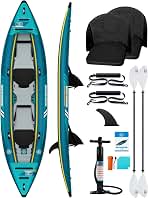
Best Overall: OCEANBROAD Inflatable Sit-in Kayak
This is the boat I would buy first if I wanted one hull to do most of the work. It is a sit-in touring design, and it can be set up for one paddler or two. That flexibility is worth more than it sounds, because it means you do not own a tandem boat you never use and a solo boat you use constantly. You own one.
The sit-in layout matters on open water. Your legs are inside the hull, so wind and spray hit the deck instead of your lap, and the lower profile gives a crosswind less to push against. That is the difference between a pleasant mile into a headwind and a slow argument with the weather.
The questions I ask on a touring hull are always the same. Does the floor hold its shape when I push off with my heels, or does it balloon under me? Does the seat back hold me upright for three miles or fold by the second? How does it behave loaded with a second paddler and gear? A touring kayak that cannot answer those is a pool float with a nicer paint job.
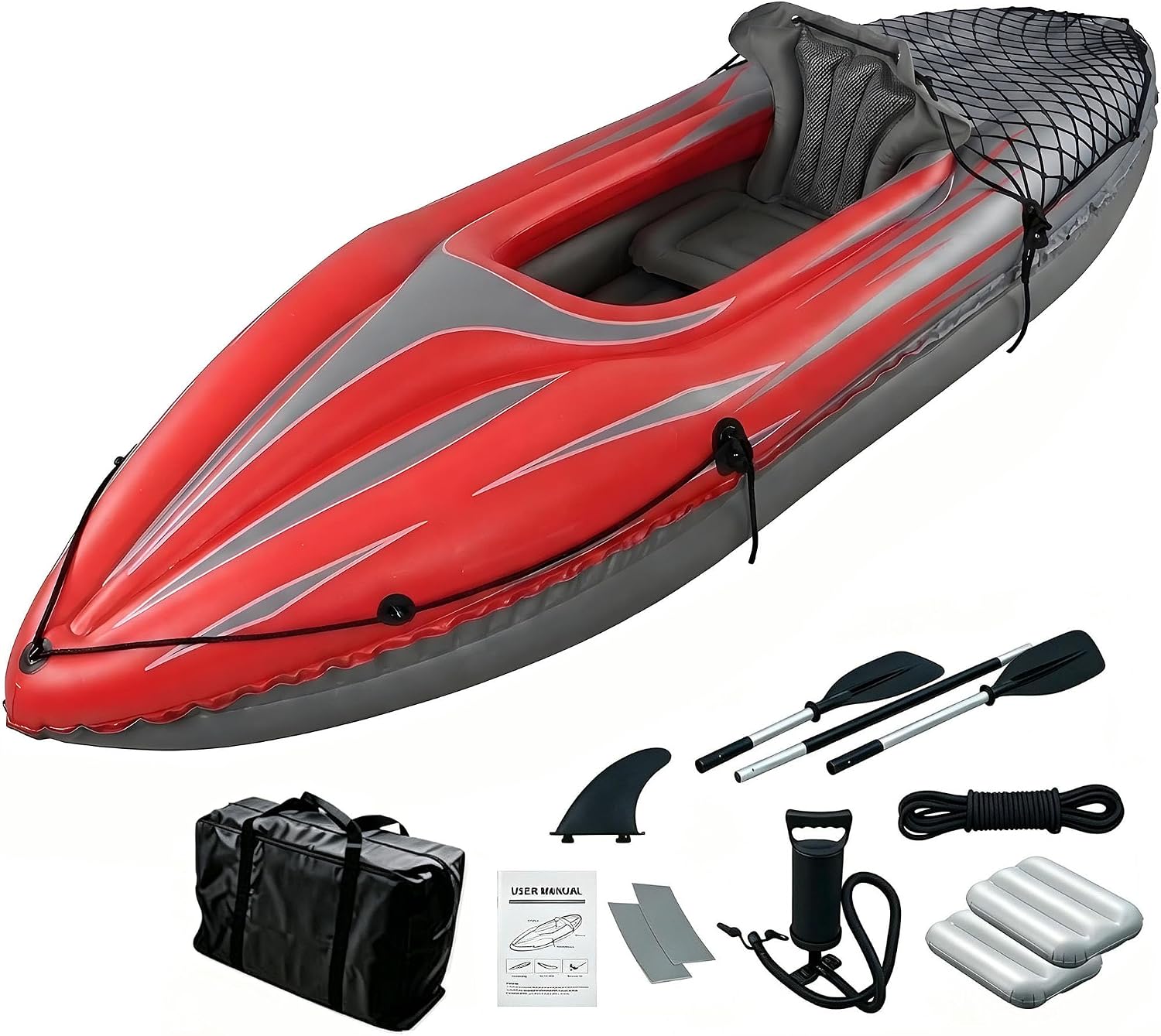
Best Value: 9 ft Inflatable Kayak, 1-Person Fishing Boat
This is the cheapest way onto flat water in this group, and the feature list reads like someone actually thought about a solo paddler. Aluminum oars, a high output pump, an adjustable seat, a removable fin, and a cargo net. Of those, the removable fin is the one I care about most. A deployed fin is the cheapest fix for bad tracking on the water, and it costs you nothing but a few seconds at the ramp.
The other thing I care about is the listed 220 lb capacity. Treat that as a lab number. It was measured on a cool day with an empty boat. Add a real paddler, a cooler, a dry bag, and a hot Florida afternoon, and you are closer to the edge than the sticker suggests. Pack light, sit still, and this hull does what it promises for lakes and slow rivers.
The solo fishing layout is a specific kind of good. You are not going to cover five miles in it. You are going to drift a shoreline, cast, and be home before lunch. If that is your trip, this is your boat.
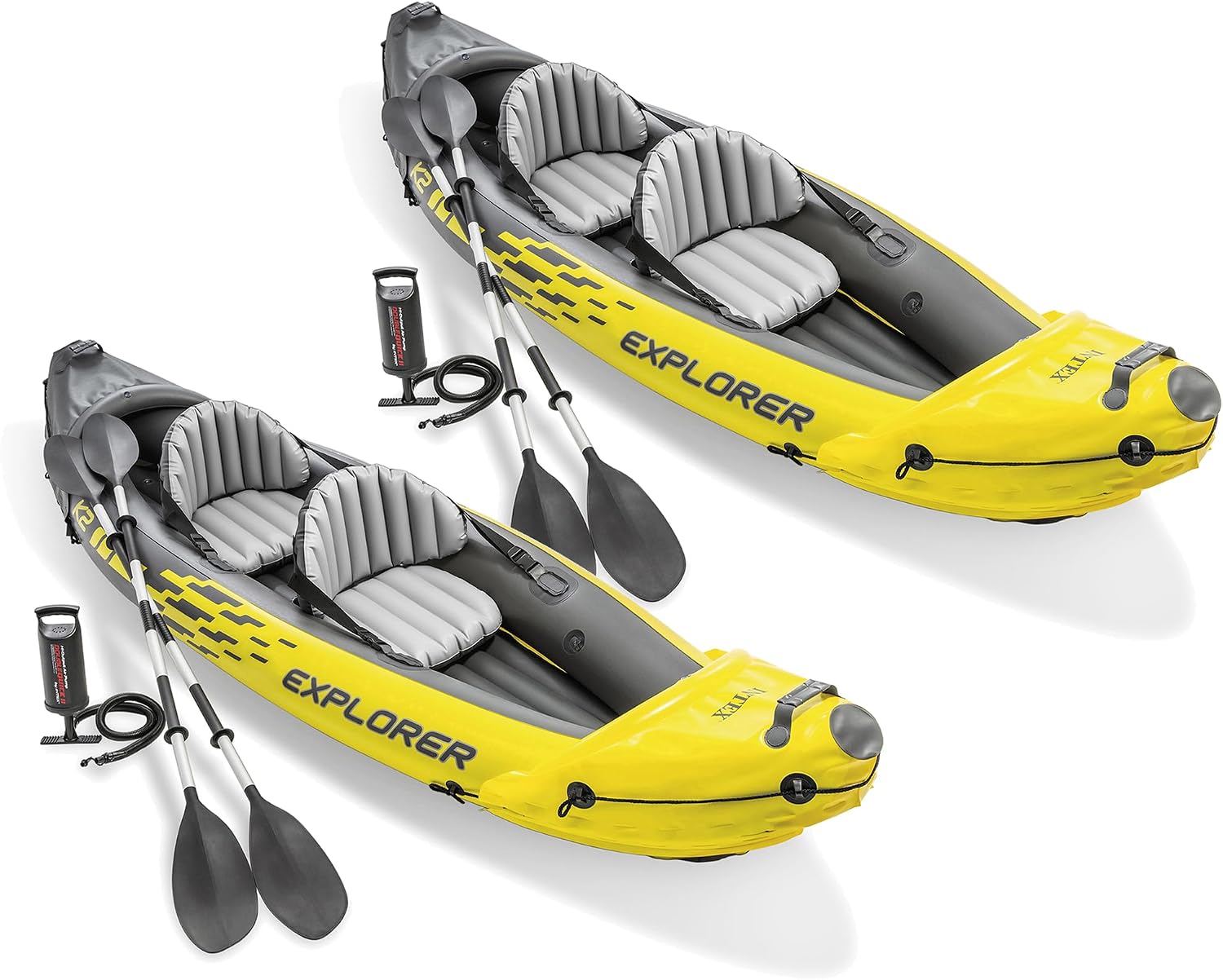
Best for Two Paddlers: INTEX Explorer Kayak 2-Person Set
Two boats, two sets of paddles, and a pump in one box. That is the whole pitch, and for a family it is a good one. When a friend or a kid shows up, nobody argues about who sits where, and nobody waits on the ramp while you inflate a second hull you did not bring.
Here is the honest part. This is a recreational hull, and I would keep it on calm lakes and slow, sandy-bottomed rivers. I would not drag it across a rocky spring run, and I would not expect it to hold a straight line in a stiff crosswind. Recreational boats wander, and you correct them. Over half a mile that is fine. Over three miles it is tiring.
For the money and the convenience, though, it is hard to argue with two complete boats. If your paddling is a couple of hours on a lake with people you like, this set is the least fussy way to get there.
Best Premium: Star Viper Inflatable Kayak
This is the most expensive boat of the four, and it is the one I would hand to somebody who paddles every week. At this price, the money is going into hull material and floor stiffness. Those two things decide everything downstream. How the boat tracks, how it takes a chop, how it feels under your heels when you push, and how cleanly it patches when the inevitable happens.
So before you spend this, ask three questions. What is the floor, and how stiff does it actually get at pressure? What is the hull material, and does it take a patch that holds? What does the boat weigh packed, wet, with the pump? If the answers are good, this is a decade-long purchase and the price is easy to justify. If the answers are vague, walk away and buy the OCEANBROAD instead.
How I tested
Same pump, same paddler, same three-mile spring run, same current. I timed three inflations per boat from bag to water, because that number tells you whether the boat fits your actual Saturday. I paddled each hull into the wind and watched how many corrections it took to hold a line. Then I packed each one wet in the rain to see how long it really takes to dry and stuff.
The durability test is the one that matters most to me. I cut into hull material on purpose, because a boat that spreads a tear is a boat that ends your trip, and a boat that patches clean is a boat you keep. I patched a cheap hull with a bicycle tire repair kit once and watched it hold three summers. That patch set the standard I judge everything else against.
Analysis and test results
Setup time is the spec that matters. Not weight, not color, not packed size. A pump that moves real air is worth as much as the hull it fills, and a boat that takes forever to reach pressure is a boat that stays in the garage. When you shop, look at the pump before you look at the kayak.
"Drop-stitch" is not a magic word. The floor stiffness is what you are actually paying for, and you can test it in a hallway. Inflate the floor, stand on it, push off with your heels. If it gives like a balloon, you are buying a float. If it holds like a board, you are buying a kayak.
Weight ratings are lab numbers. A 220 lb rating means 250 lb of paddler and gear on a hot afternoon is asking for trouble. Add up your body weight, your cooler, your dry bag, and your dog, and be honest about the total.
Tracking is a wind problem more than a hull problem. A deployed fin or skeg fixes wandering cheaply, which is why the removable fin on the 9 ft boat matters so much for the price. Rocker plays a role too. More curve turns easier and rides chop; less curve tracks straighter and paddles faster. Know which one your water demands.
Tandem versus solo is a real decision, not a marketing one. The OCEANBROAD converts between both, the INTEX set gives you two hulls for two people, and the 9 ft boat is honest about being a one-person platform. Buying a tandem "for guests" usually means owning a heavy solo boat.
Patchability is the long game. Vinyl and coated fabric do not fail the same way, and glue that has dried out in the tube is worse than no patch kit at all. Check the kit before you need it, and keep a spare in the truck.
The inflatable kayak reference table
| Kayak | Best for | Paddlers | Why it stands out | Price |
|---|---|---|---|---|
 Visit on Amazon → OCEANBROAD Inflatable Sit-in Kayak |
One hull for solo and tandem days | 1 or 2 | Sit-in touring design that converts, so no second boat needed | $505.95 |
 Visit on Amazon → 9 ft Inflatable Kayak, 1-Person Fishing Boat |
Solo flat-water paddling and fishing | 1 | Aluminum oars, high output pump, adjustable seat, removable fin, cargo net | $97.00 |
 Visit on Amazon → INTEX Explorer Kayak 2-Person Portable Set |
Families, guests, and calm lakes | 2 per boat, 2 boats | Two complete boats with paddles and pump included | $300.39 |
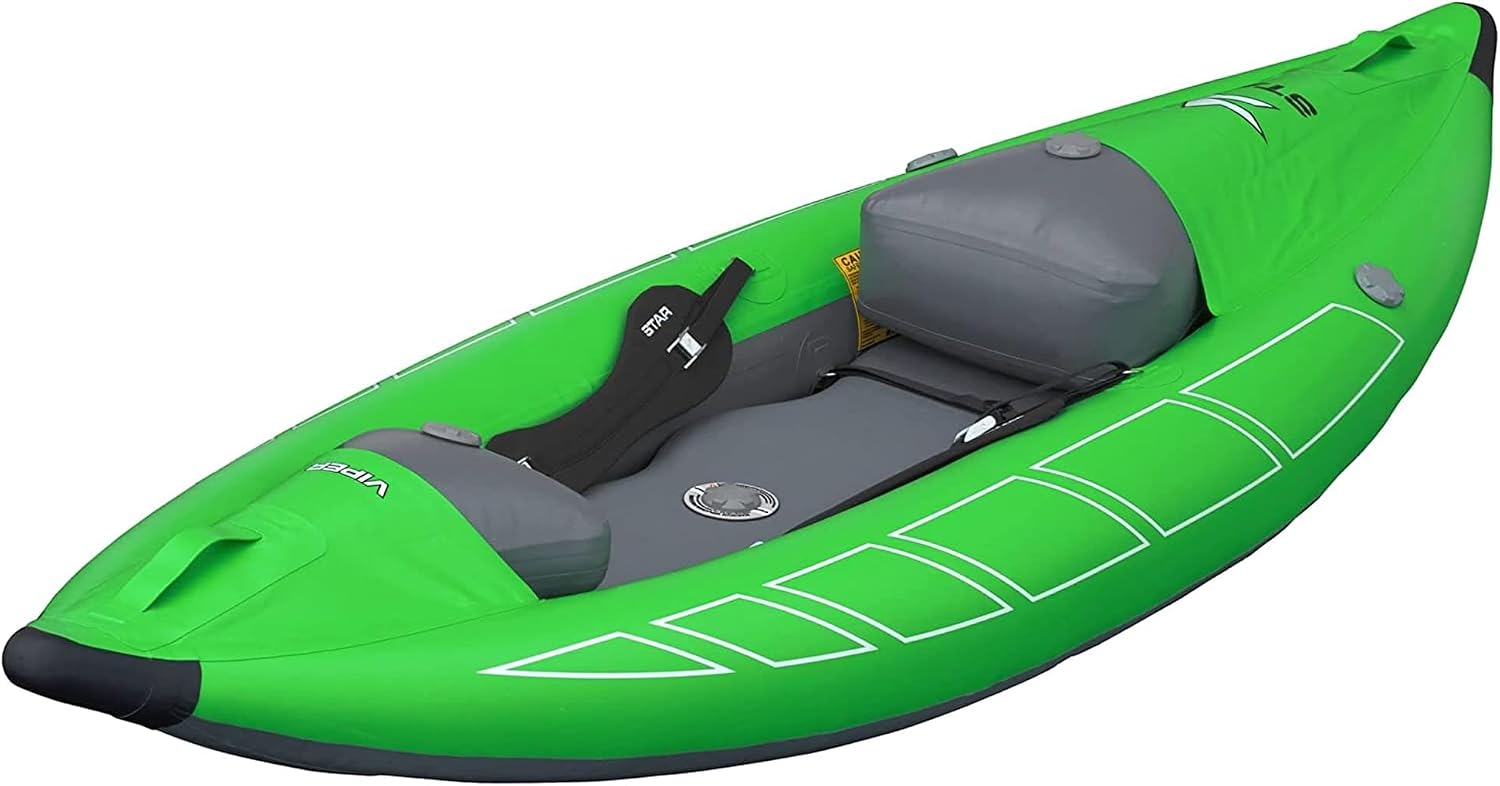 Visit on Amazon → Star Viper Inflatable Kayak |
Weekly paddlers who want to pay once | Confirm at the listing | Premium hull where material and floor stiffness carry the price | $1,195.00 |
What I would skip
Electric pumps advertised as hands-free that need a car battery and twenty minutes. Patch kits with glue that has dried out in the box, which is most of them. "Packs to the size of a backpack" claims, when the backpack is the size of a body bag. And any "10-minute setup" claim from someone who has clearly never held a stopwatch on a boat ramp.
Should you buy the OCEANBROAD Inflatable Sit-in Kayak?
Yes, if you want one boat that handles a solo spring run and a paddle with a friend. The sit-in touring layout keeps spray off you, the lower profile handles wind better than a sit-on-top, and the one-or-two person setup means you are not maintaining two hulls. It is the best overall pick here for a reason.
Should you buy the 9 ft Inflatable Kayak?
Yes, if your trip is a solo drift along a shoreline with a rod in your hand. The removable fin is the tracking fix most cheap boats lack, the pump and oars come with it, and the cargo net holds a small cooler. Just respect the listed capacity and pack light. This is a flat-water boat, and it is a good one for the money.
Should you buy the INTEX Explorer Kayak 2-Person Set?
Yes, if you want two boats, two paddles, and a pump without thinking about it. It is the least fussy way to get a family onto a calm lake. No, if you plan to paddle rocky spring runs or fight a crosswind for three miles. Recreational hulls wander, and this one is honest about what it is.
Should you buy the Star Viper Inflatable Kayak?
Yes, if you paddle weekly and you would rather buy once. At this price you are paying for hull material and floor stiffness, and those are the two things that decide tracking, chop behavior, and how well the boat patches when it eventually needs it. Ask those questions first. If the answers are solid, this is the last inflatable you buy for a long while.