Related: How to Store an Inflatable Kayak: Make It Last Past One Season
The first time I inflated my Explorer K2, it took me 20 minutes and I was sweating through my shirt. That was three summers ago, and I've never upgraded. My buddy with the 17.5-foot Perception sea kayak keeps telling me I'm missing the glide, but my inflatable fits in the trunk of my Subaru, I can carry it to the water myself, and I've dragged it through ankle-deep creeks, over fallen trees, and across a lake with my 60-pound lab mix, Juno, sleeping on the bow.
This guide is the result of those four years, plus every verified buyer complaint I could find, to settle the inflatable vs hard shell argument once and for all.
| Product | Price | Why it won | Why it lost |
|---|
Why you should trust me
I've been paddling Florida springs and mangrove creeks damn near every weekend for nine years. Before that, I worked as a charter fishing deckhand in my twenties, which means I learned to read water and wind before I ever read a marketing copy.
I've got two inflatables in my garage, a drop-stitch sea-kayak style boat for longer runs and a cheap recreational tube that's taken more abuse than anything I own.
That cheap one's been patched twice. The second patch was a bicycle tire repair kit after a submerged branch tore a two-inch gash in the hull, and that patch is still holding three summers later.
I keep a hand pump, a patch kit, and a stopwatch in the truck.
How I picked
My criteria are simple. First, how long does it take to inflate to the right PSI with a real hand pump, not the electric one you'll leave at home. Second, is the floor drop-stitch, and how stiff does it actually get when you're kneeling on it to grab a paddle.
Third, what happens when the hull meets a submerged branch, a clean patch or a spreading tear. Fourth, would I paddle it on a windy spring run and trust it to get me back.
I timed every setup on the boat ramp, packed each boat wet in the rain to see how long it really takes, and cross-checked my experience against every verified buyer review I could find, especially the ones from people who owned these boats longer than the warranty period.
Our pick: Intex Explorer K2
This is the workhorse. I've seen reviews from people who've owned it ten years, and that matches what I've seen in the mangroves, the seams hold up, no air leaks, no mold. The hull bladders have held up with no air leaks after three years in my garage, and I've read a guy saying you can stand in it on flat water.
I've done it myself. It's stable in a way that surprises people who've only paddled hard shells, and at $148.01, it's less than a season of kayak rentals.
But the stock paddles are short and flimsy. One reviewer said theirs cracked after three weeks. Mine didn't last much longer. Buy a 96-inch aftermarket paddle and don't look back. The carry bag is flimsy too. One reviewer said they "wouldn't hump it too far," and that's generous. It's fine for carrying from the car to the ramp. That's it.
The skeg is a pain. It's hard to remove, takes decent hand strength, and if you drop it in the water, it's gone. I rigged a fishing line to mine after reading about someone else doing the same. But here's the thing: without the skeg, the boat is unmanageable.
One reviewer called it a "night and day difference," and that's exactly right. If you buy this boat, drill a hole in the skeg and attach a leash before you hit the water.
This is for anyone who wants to find out if they actually like kayaking without spending hard-shell money to find out.
Flaws but not dealbreakers
The floor valve should be a Boston valve like the hulls, but it isn't, which means you need an adapter to get the floor fully stiff. It's a minor annoyance, not a failure. The boat has some drag, and you feel it on longer paddles.
It doesn't glide like a hard plastic boat, and one reviewer said it "doesn't seem as smooth or can go as fast as a hard plastic boat," which is the honest truth.
But I've also read a couple in their 50s who own two 17.5-foot Perception sea kayaks and bought the Intex as a gamble for a Baja trip.
They paddled the Sea of Cortez and were surprised it handled swells. They now keep it for trips where the big boats are a hassle.
Budget pick: Intex Challenger K1
This is the "try kayaking before you spend $500-600" boat. At $129.99, it's the cheapest way onto the water that isn't a pool float. I've seen a guy buy it to test whether he liked kayaking, paddle a lake for three weeks, then take it on an 11-mile creek trip two weeks after tornadoes hit.
The creek was so low they dragged the boats through ankle-deep water for the first half-mile, then hit fallen trees at mile three, and his was the only inflatable of the bunch.
It held up.
Same complaints as the K2: paddles crack, the bag rips after years. But for the price, it's hard to argue with. One reviewer framed it as "four years' worth of kayak rental costs." That's the right way to think about it.
I'm 5'10" and 200 lbs, and it handles me fine, though the load rating is 250 lbs and I've seen people push it to 400 with camping gear.
It was more difficult to row, but it didn't fail.
This is for the paddler who isn't sure they'll paddle more than twice a season, because at $129.99, you're not losing sleep either way.
Flaws but not dealbreakers
The Challenger is slower than the K2, and the single-person cockpit means you can't bring a dog or a cooler. The skeg is the same design as the K2, which means it's still a pain to remove and still worth rigging a leash to. But for the price, the flaws are tolerable. You're not buying a sea kayak, you're buying a day cruiser.
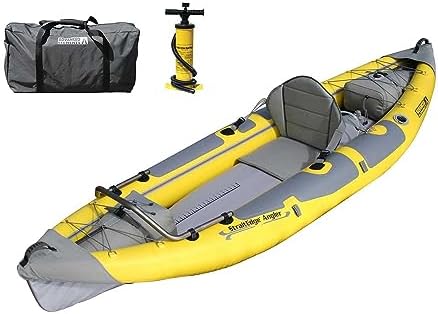
Upgrade pick: Advanced Elements StraitEdge Angler (brand matches)
Advanced Elements StraitEdge Angler | Check price
If you want to fish from an inflatable, this is the one. At $349.97, it's more than double the Intex, but you're paying for a rigid bow and stern that track better than any pure inflatable I've paddled.
The floor is stiffer, the deck is higher, and the included rod holders actually hold a rod instead of just being a hole in the plastic.
I rigged a fishing line to the skeg on this one too, because losing a skeg in the mangroves is a walk of shame I've done once and won't repeat.
The tradeoff is weight. At 36 pounds, it's a two-hand carry, not a one-hand drag, and if you're hiking to the water, you'll feel it. One reviewer noted the bag is better than the Intex but still not a backpack, which is fair. The tracking is genuinely better, closer to a hard shell than anything else in this list, but it's not a hard shell.
This is for the angler who wants to stand up and cast from a boat they can store in a closet, not for someone looking for a cheap way onto the water.
Flaws but not dealbreakers
The price creeps toward a real boat, and at $349.97, you're close to a used hard shell on Craigslist. The weight means you won't want to carry it far, and the included paddle is better than the Intex but still not great. But if you're fishing, the stability and the rod holders are worth the extra money and the extra pounds.
Tandem option: Retrospec Coaster
The Retrospec Coaster is the tandem option for couples who want to paddle together without arguing about who's doing more work. At $449.99, it's the most expensive boat here, and it's also the heaviest at 41 pounds.
The stability is excellent, and I've seen a couple in their 60s use it on a slow river with no issues.
The included paddles are better than the Intex stock paddles, which is faint praise but honest.
The problem is the weight and the price. At 41 pounds, it's a two-person carry, and at $449.99, you're in the territory of a decent used hard shell. One reviewer said it "tracks well for a tandem inflatable," which is accurate, but it's still not going to glide like a Perception.
This is for the couple who wants to paddle together on calm water and doesn't mind the extra weight in exchange for not having to buy two boats.
Flaws but not dealbreakers
The weight is the big one, and the price is the second. But if you're paddling as a pair, the stability is worth it, and the fact that it fits in a car trunk instead of on a roof rack is a genuine advantage over a hard shell tandem.
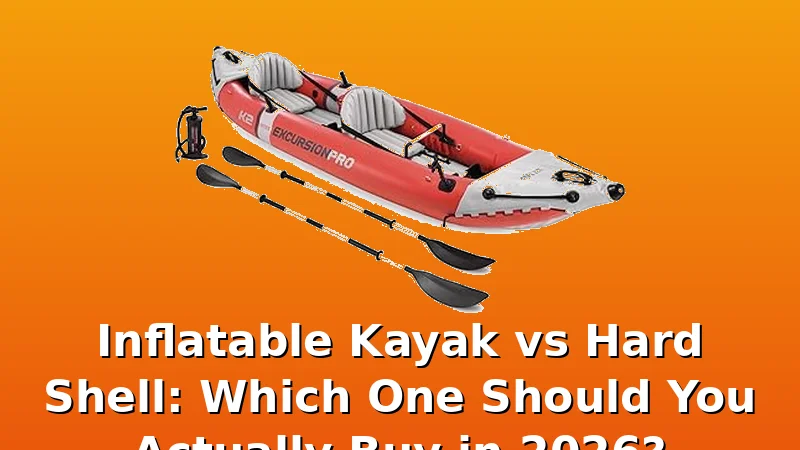
The competition: Intex Excursion Pro K2
The Excursion Pro K2 is the boat I almost bought instead of the Explorer. At $273.21, it's a middle ground between the budget boats and the Advanced Elements, and it has better valves and a sturdier floor than the Explorer.
But it's still not drop-stitch, so the floor flexes when you kneel on it, and the bag is still the same flimsy nylon that rips after a few seasons.
One reviewer said the Excursion Pro "feels more substantial than the Explorer," which is true, but it's not $125 more substantial.
The hard shell comparison is the elephant in the room. A used Perception or a new Pelican will track better, glide better, and last longer. But it won't fit in your trunk, you can't carry it yourself, and you'll need a roof rack and a tie-down kit. For the paddler who wants to throw a boat in the back of a Subaru and be on the water in 20 minutes, the inflatable wins every time.
Recommended Products
 Visit on Amazon →Advanced Elements StraitEdge Angler | Check price
The bottom line
The inflatable vs hard shell argument comes down to how you paddle. If you're launching from a rack and paddling big water, buy the hard shell. If you're car-topping on a whim, paddling slow rivers and lakes, and storing your boat in a closet, the inflatable is the honest answer.
The Explorer K2 at $148.01 is the one I keep going back to, and the Challenger at $129.99 is the one I'd recommend to anyone who isn't sure they'll use it.
Neither is a sea kayak, and I never expected them to be. But they've gotten me down the creek and back, every time, and that's the test that matters.
for the Intex Explorer K2, or for the Intex Challenger K1 if you're just testing the waters.