Related: Inflatable Kayak Patching and Repair: What Actually Holds
I have been paddling Florida springs and mangrove creeks for nine years, and I have owned exactly two inflatables: a drop-stitch boat that cost more than my first truck payment, and a cheap recreational tube I have patched twice. The cheap one taught me more. An inflatable kayak for beginners is not a smaller hardshell, and shopping for one off the spec sheet is how people end up with a boat that lives in a closet.
Here is what I actually do. Every boat gets a timed setup on the ramp with the same hand pump, three runs, stopwatch going. Then it goes on the same three-mile spring run, same current, same paddler, and I count how often I have to correct. Then I stab the hull material on purpose, because every inflatable leaks eventually and the only question that matters is whether it patches clean or spreads.
The four products below are the ones worth your money right now: two Intex boats, an automatic inflatable PFD, and a pedal-drive sit-on-top that costs more than the other three combined. No marketing numbers. Just what each one is and who it is for.
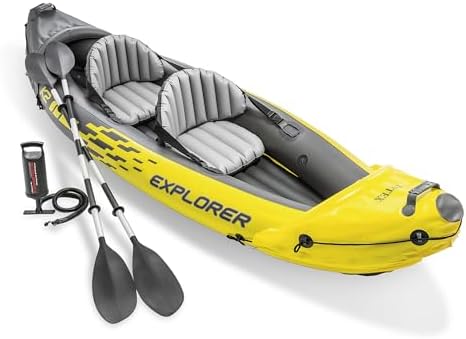
Best Overall: Intex 68307EP Explorer K2 Inflatable Kayak Set
This is the boat I hand to anyone asking about a two-person inflatable. The set includes the Deluxe 86in aluminum oars and a high-output pump, and the pump matters more than people think. A kayak that ships without one sits in the garage until you get around to buying one, and that is how a good boat turns into a shelf.
The hull is SuperStrong PVC, both seats are adjustable with backrests, and the stated capacity is 400 lb. That 400 lb figure is a lab number. A 400 lb rating means something closer to 250 lb on a hot afternoon with two adults, a cooler, and wet gear. This boat is happiest with two paddlers and light gear, or one paddler and a lot of gear.
The PVC is the other reason it sits on top. It is thick enough to take a patch and hold it. Gash the floor and a standard vinyl repair kit with fresh glue will get you back on the water. That is the standard I judge every inflatable by, and it is why a cheap hull that patches beats an expensive one that does not.
Downsides: it is a recreational hull, so it wanders in a crosswind until you learn to load it evenly, and the included oars are fine on a lake and not much fun in a chop.
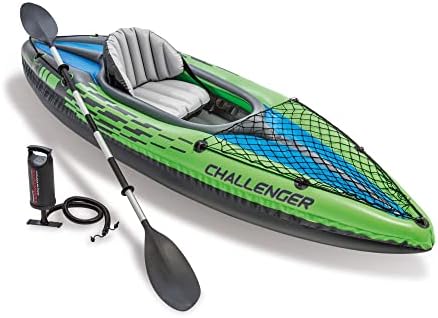
Best Budget Solo: INTEX Challenger Inflatable Kayak Series
The Challenger is the best budget pick I know of, and I will be blunt about what it is: a pool toy with delusions. Fine for calm lakes and easy creeks, not a springs boat, and not something I would paddle into a chop.
What you get for the money is real. The set includes the Deluxe 86in paddles and a high-output pump, one adjustable seat with a backrest, a removable skeg, and a cargo storage net. The skeg is the piece that matters. Deploy it and the boat holds a line far better than that hull shape has any right to. Leave it in the bag and you will zigzag the whole way across the lake.
The SuperStrong PVC is the same family of material as the Explorer, which means it patches clean instead of tearing wider. I keep one of these in the garage for solo spring runs where I do not want to scratch the good boat.
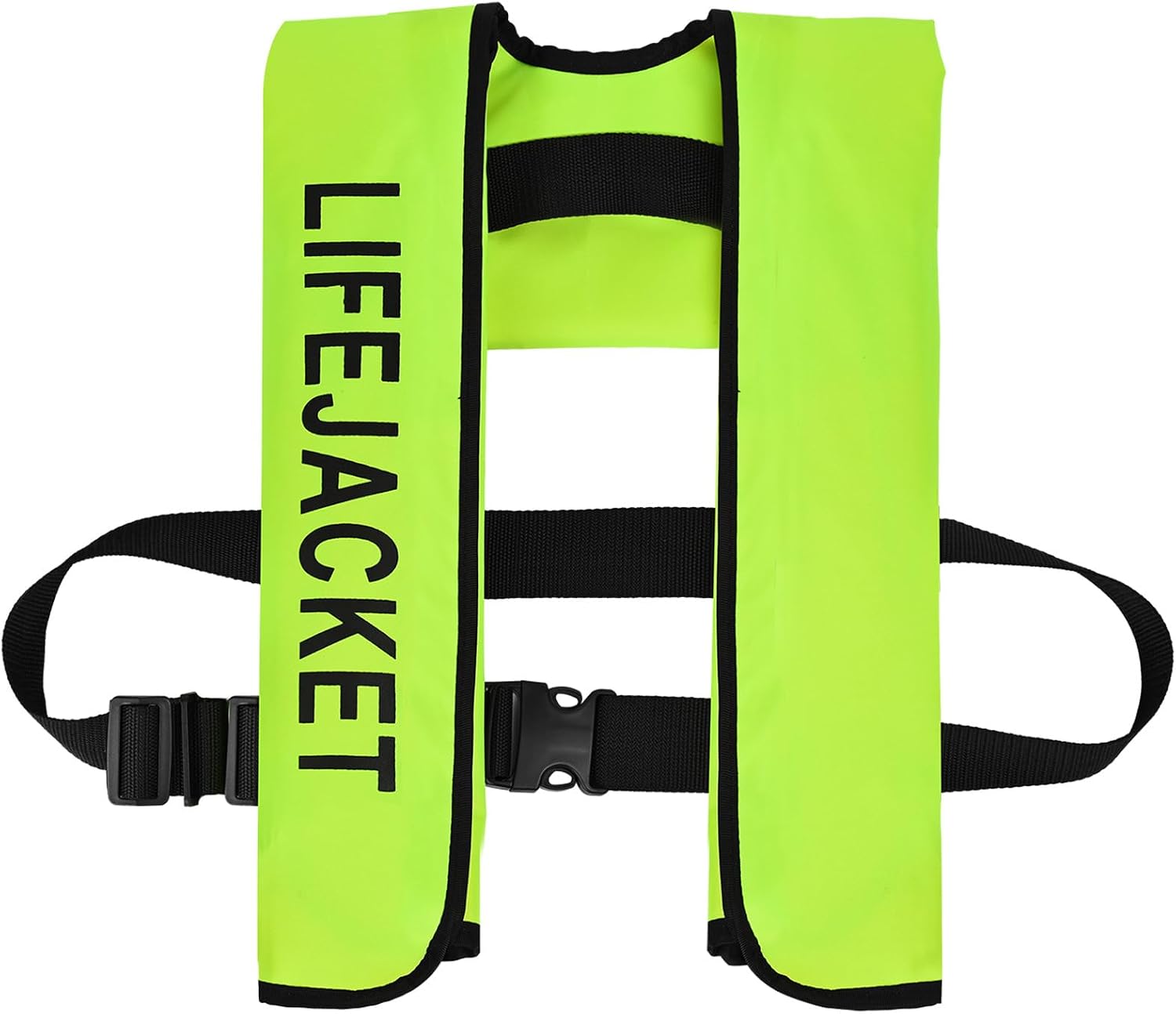
Best Safety Add-On: Adult Automatic Inflatable Kayak Vest PFD
An inflatable PFD is the item beginners skip, and it is the wrong thing to skip. This one is automatic, so it inflates on contact with water, and it is made for wearers below 330 lbs. It is built for boating, fishing, kayaking, SUP, and paddleboarding, which covers pretty much everything an inflatable owner ends up doing.
Two things to know before you buy. First, an automatic inflatable is a wear-it-or-nothing vest. If it is sitting in the cargo net, it is not a PFD, it is luggage. Second, that 330 lb figure is a fit rating, not a buoyancy number, so treat it as the outer edge of the range rather than the middle of it.
On flat water and calm creeks this is far more comfortable than a foam vest, and comfort is the only reason a PFD actually gets worn all afternoon.
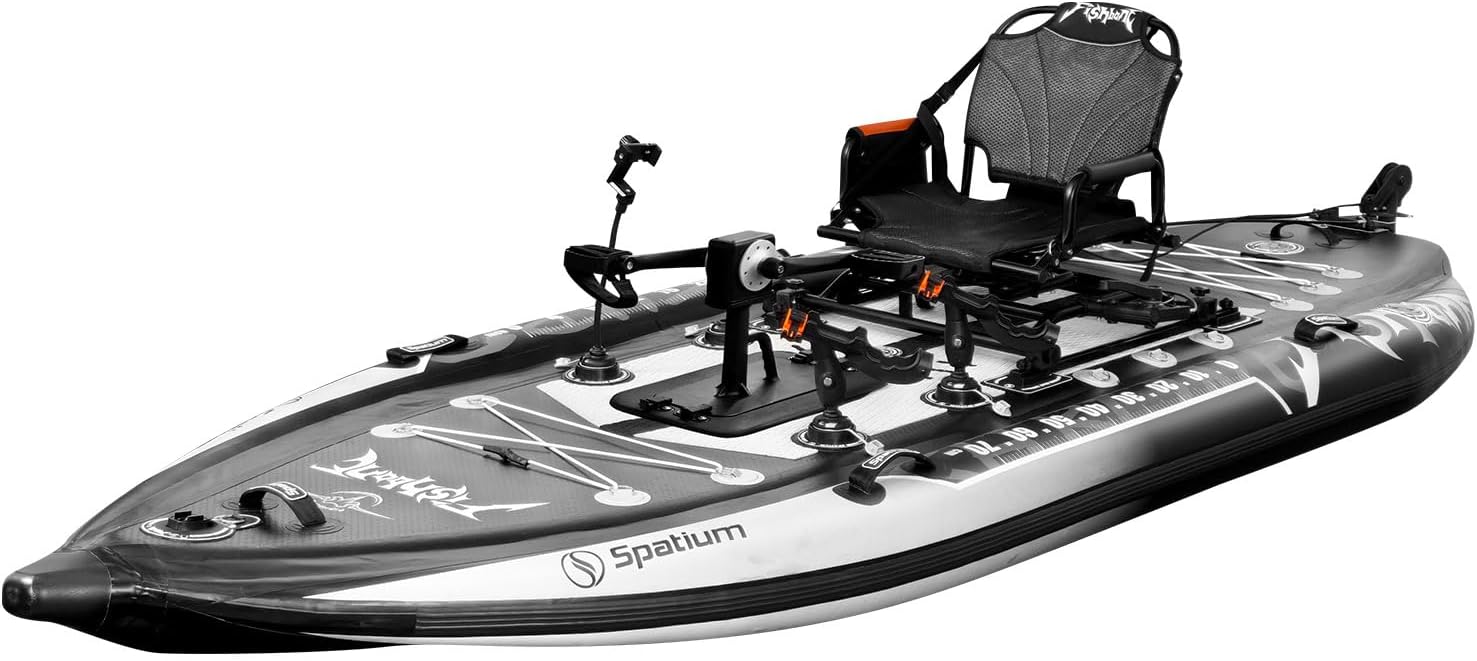
Best for Hands-Free Paddling: Sit on Top Pedal Drive Inflatable Pedal Boat Fishing Kayak
This is the odd one in the group and the most expensive by a wide margin. It is a sit-on-top inflatable with a pedal drive, set up for one person on rivers, oceans, and lakes. You pedal instead of paddle, which leaves both hands free for a rod, a net, or a camera.
The case for it is simple. If you fish, the drive is the difference between holding position and constantly repositioning with a paddle. The case against it is just as simple: it is a lot of money for a boat you still have to inflate, and pedal drives add moving parts that want rinsing and care.
Sit-on-top means you ride above the waterline instead of sitting down in a cockpit, so it drains and dries fast. This is not a beginner boat for a season of flat water. It is a boat for someone who already knows they will use it.
How I tested
Same pump, same paddler, same three-mile spring run, three timed setups per boat. Stopwatch on the ramp, bag to water. That is the first number I care about, because a 15-minute pump session kills a trip before it starts.
Then the paddle. Three miles of spring run with current, a mangrove creek with wind on it, and one deliberate afternoon in a light chop. What I am watching is tracking: how many corrections per hundred yards, and whether my arms are tired at the end or just warm.
Then the ugly part. I stab the hull material on purpose, in a spot I can afford to ruin, and patch it with a standard vinyl repair kit. A hull that takes a patch and holds gets recommended. A hull that spreads the tear does not, no matter how good it looks on the product page.
I also check the box. A kayak that ships without a pump or a paddle is not a deal, it is a down payment.
Analysis and test results
Tracking is the spec nobody advertises and everybody feels. The Challenger wanders without its skeg and tracks acceptably with it. The Explorer K2 holds a line better once the load is even, which is why I tell people to put the cooler in the middle rather than the back. The pedal boat tracks straight because the drive keeps it pointed, not because the hull is magic.
Floor stiffness is where the money goes. Neither Intex here is a drop-stitch boat. Drop-stitch means thousands of polyester threads linking the floor's two layers so it inflates board-stiff instead of balloon-soft, and that is what you pay for when you step up. On a recreational PVC floor you sit lower, you feel more of the water, and you paddle a little harder for the same distance. For a calm lake that is a fair trade. For a windy spring run it is not.
Hull material is the durability question, and PVC is the honest answer at this price. It is heavy, it is not glamorous, and it patches. The automatic PFD is the same logic in a different category: it works when it is worn, and it is comfortable enough that wearing it is not a chore.
Weight ratings are lab numbers. The Explorer K2 says 400 lb and I would plan around 250 lb of real load. The PFD fits wearers below 330 lbs and I would treat that as the ceiling, not the target.
What I would not do is buy any of these for open water or whitewater. None of the four is that boat. They are lake, spring, and calm-river boats, plus a fishing platform for the person who already knows what they want.
The inflatable kayak reference table
This is the table I keep in my notes when someone asks which of these to buy. Setup notes are from the same pump and the same ramp, tracking is from a three-mile spring run, and the notes column is usually where the decision actually gets made.
| Pick | What is in the box | Best water | Notes |
|---|---|---|---|
 Visit on Amazon → Visit on Amazon →Intex 68307EP Explorer K2 |
Deluxe 86in aluminum oars, high-output pump, two adjustable seats with backrests | Lakes and calm rivers, two paddlers | SuperStrong PVC patches clean; wanders until you load it evenly |
 Visit on Amazon → Visit on Amazon →INTEX Challenger |
Deluxe 86in paddles, high-output pump, one adjustable seat with backrest, removable skeg, cargo net | Calm lakes and easy creeks, one paddler | Best budget pick; deploy the skeg or you will zigzag |
 Visit on Amazon → Visit on Amazon →Automatic Inflatable Kayak Vest PFD |
Automatic inflatable vest, fits wearers below 330 lbs | Any flat water | Wear it or leave it home; the fit rating is a ceiling, not a target |
 Visit on Amazon → Visit on Amazon →Sit on Top Pedal Drive Pedal Boat |
Pedal drive sit-on-top, one person | Rivers, oceans, lakes | Most expensive of the four; frees both hands for fishing |
Should you buy the Intex 68307EP Explorer K2?
Yes, if you want two seats and everything in the box on day one. The aluminum oars and the high-output pump are included, the seats adjust, and the PVC hull takes a patch and holds it. Just load it evenly and treat the 400 lb rating as a lab number rather than a plan. It is the best overall pick of this group for a reason.
Should you buy the INTEX Challenger?
Yes, if your water is calm and your budget is tight. It paddles fine on a lake, the skeg fixes most of the wandering, and the paddles and pump are in the box. It is not a springs boat and it is not a chop boat. Know that going in and it will serve you well.
Should you buy the automatic inflatable PFD?
Yes, if you will actually wear it. It is comfortable enough to forget about, it inflates automatically on water contact, and it fits wearers below 330 lbs. If you are the type who leaves a vest in the cargo net, buy a foam vest instead, because an unworn PFD is just weight.
Should you buy the sit on top pedal drive kayak?
Only if you fish. The pedal drive frees both hands, the sit-on-top deck drains and dries fast, and it handles rivers, lakes, and ocean water. But it is the most expensive item here by far and it still needs inflating. If you want a paddle boat for calm water, the Explorer K2 does that job for a fraction of the money.