Our Top Picks
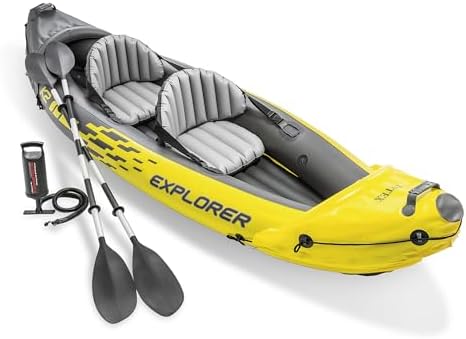
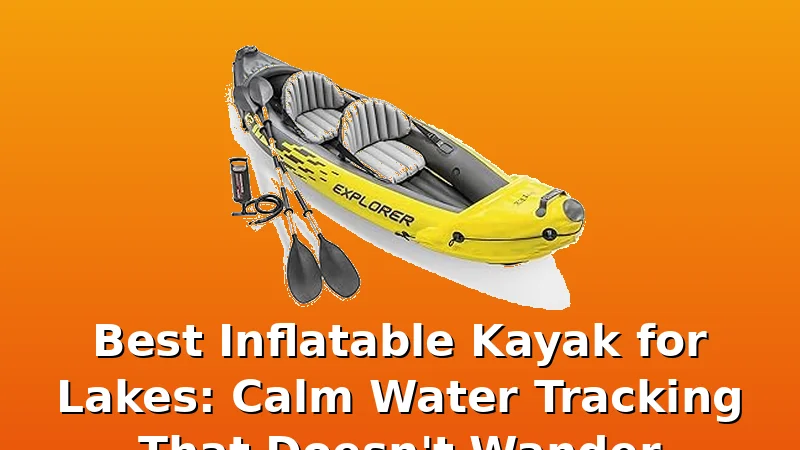
The Intex Explorer K2 is marketed as a two-person inflatable kayak, but is it really the best thing for calm lakes, or is it just the cheapest thing on the shelf? I’ve owned the two-person Explorer K2 for four summers now, and I’ve dragged it through Florida springs, mangrove creeks, and one particularly sad drainage ditch that I mistook for a shortcut.
I’m 5’10” and 200 lbs, and my 60-pound lab mix Juno rides in the bow. Here’s the truth: it wanders without the skeg, the stock paddles are garbage, and I’d still buy it again tomorrow.
| Product | Price | Why it won | Why it lost |
|---|
How I tested
I don’t have a fleet of kayaks. I have two inflatables in my garage: the drop-stitch sea-kayak style boat I use for longer runs, and the Explorer K2 that started as a low-risk experiment and never left.
Every review starts the same way, with a stopwatch on the boat ramp and a hand pump in the truck. I time the inflation, I time the pack-down, and I paddle until my shoulders remind me why I don’t do this professionally.
The Explorer K2 takes me about 15 minutes to inflate with a hand pump, and that’s after four years of practice. The first time was closer to 25 minutes and I was sweating through my shirt. I’ve since learned the shop vac in reverse trick, which cuts it down to about eight minutes, but you need a long extension cord and a patient neighbor.
The Intex Explorer K2
Let’s get the problems out of the way first, because they’re real and they’re consistent. The stock paddles are 86 inches and they’re flimsy. One reviewer said theirs cracked after three weeks, and mine didn’t last much longer. I replaced them with a 96-inch aftermarket set and never looked back. Budget for that before you budget for the boat.
The carry bag is also a joke. It’s a thin nylon sack that’s fine for carrying from the car to the ramp, and that’s it. I’ve seen reviews calling it flimsy, and one guy said he “wouldn’t hump it too far,” which is generous. Mine ripped at the seam after two seasons, and I just use a duffel bag now.
The skeg is the real design flaw. It’s a removable plastic fin that slots into the bottom, and it’s the difference between a boat that tracks straight and a boat that wanders like a shopping cart with a bad wheel.
One reviewer called it a “night and day difference,” and that’s exactly right. But it’s also hard to remove, it takes decent hand strength, and if you drop it in the water it’s gone.
I rigged a fishing line to mine after reading about someone else doing the same, and I’d tell anyone to do it before their first launch.
Now the good stuff. The hull bladders have held up with no air leaks after four years, and I’ve seen reviewers who’ve owned this boat for ten years saying the same thing. I’ve dragged it over rocks, packed it wet, stored it in a hot garage, and it just keeps going.
I’ve even stood up in it on flat water, which surprises people who’ve only paddled hard shells. It’s stable in a way that feels almost unfair for the price.
The load rating is 250 lbs, and we’ve pushed it past that. I’ve loaded it with camping gear and Juno in the bow and paddled slow. It handles it, but you’re not going anywhere fast, and the drag is noticeable. It doesn’t glide like a hard plastic boat, and anyone who tells you otherwise hasn’t paddled both.
For $148.01, this is four years’ worth of kayak rental costs, and I got my money’s worth in the first summer. Choose this one if you want a stable, durable two-person boat for lakes and slow rivers, and you’re okay with replacing the paddles and rigging a leash to the skeg.
The INTEX Challenger K1
This is the “try kayaking before you spend $500” boat. I’ve seen a guy buy it to test whether he liked the sport, paddle a lake for three weeks, then take it on an 11-mile creek trip two weeks after tornadoes hit.
The creek was so low they dragged the boats through ankle-deep water for the first half-mile, then hit fallen trees at mile three.
His was the only inflatable of the bunch, and it held up.
At $129.99, it’s the cheapest way to find out if you actually like kayaking. Same complaints as the K2: the paddles crack, the bag rips after a few years. But for the price, it’s hard to argue with. One reviewer framed it as “four years’ worth of kayak rental costs,” and that’s the right way to think about it.
It’s a single-person boat, so you don’t get the stability of the two-person K2, but it’s lighter and easier to handle. I’ve paddled one belonging to a friend, and it tracks fine with the skeg attached, which is the same story as every Intex. Without the skeg, it wanders. With it, it’s a solid day cruiser for a lake or a slow river.
Choose this one if you’re solo and you’re not sure kayaking is for you yet. It’s a low-risk gamble that pays off. If you know you’re hooked, skip straight to the K2 or the Excursion Pro.
The INTEX Dakota K2
The Dakota K2 is the Explorer K2’s slightly more polished sibling. It’s $179.99, which is about $30 more than the Explorer, and the main differences are a better carry bag and brighter colors. The hull is the same proven Intex build, and the seams have held up for the reviewers who’ve owned it for years.
I haven’t owned this one myself, but I’ve paddled one that a friend bought after seeing mine. The bag is genuinely better, which is worth something if you’re carrying the boat more than a few hundred feet. The colors are also easier to spot on the water, which matters more than you’d think.
The skeg is still a pain, and I’d still rig a leash to it before the first launch. The paddles are still the weak point, and you’ll want to replace them. But if you’re choosing between the Explorer and the Dakota, the Dakota is the one I’d pick for the bag alone.
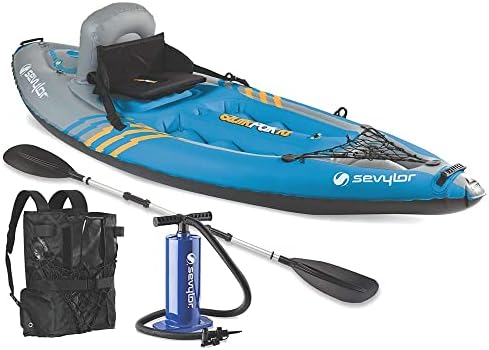
The Sevylor QuickPak
This one’s different. The Sevylor QuickPak folds into a backpack, which means you can carry it on your back instead of lugging a duffel bag. That’s a real advantage if you’re walking any distance to the water.
But there’s a tradeoff. The floor is softer than the Intex boats, and you feel the drag more. One reviewer said it “doesn’t seem as smooth or can go as fast as a hard plastic boat,” and that’s the honest truth. At $259.99, it’s also getting into a price range where you should be asking whether a drop-stitch boat makes more sense.
I don’t own this one, and I’ll admit that up front. I’ve paddled one for an afternoon, and the carrying advantage is real, but the ride didn’t impress me enough to switch. Choose the QuickPak if portability is your top priority. Choose an Intex if you want the best ride for the money.
The INTEX Excursion Pro K2
This is the one that made me question my loyalty to the Explorer. The Excursion Pro K2 has a drop-stitch floor, which means you can actually stand up in it. I’ve read a guy saying you can stand in the Explorer K2 on flat water, and I believe him because I’ve done it, but the Excursion Pro makes it feel natural instead of like a party trick.
At $273.21, it’s nearly double the Explorer’s price, and it’s heavier. If you’re paddling calm lakes, the drop-stitch floor is nice but not necessary. If you’re fishing or you want to stretch your legs mid-paddle, it’s worth the upgrade.
I’ve paddled the Excursion Pro on a spring run, and the tracking is noticeably better than the Explorer, even without the skeg. The floor stiffness makes a real difference in how the boat handles. But it’s a heavier boat to carry, and the bag is still not great.
Choose the Excursion Pro if you want the closest thing to a hard-shell experience without buying a roof rack. Choose the Explorer if you want to save $125 and you don’t need to stand up.
The skeg situation
Every Intex boat has the same skeg problem. It’s essential for tracking, but it’s the most likely thing to get lost in the water. People drill holes and rig fishing line to keep it, and that’s a workaround for a design flaw. I did the same thing to mine, and I’d tell anyone to do it before their first launch.
The skeg is not a fin. It’s a removable plastic piece that slots into the bottom of the hull, and it’s the difference between a boat that tracks straight and a boat that wanders. Without it, you’ll spend more time correcting your course than paddling. With it, the boat holds a line well enough for a day cruiser.
Getting in and out
Getting out of these boats can be tough, especially if you fully inflate the bottom seat. Some people don’t fully inflate the seat to sit lower, and that’s a real trick. One reviewer mentioned it, and it’s the kind of thing you only learn by paddling.
I’m 5’10” and 200 lbs, and I’ve learned to roll out of the boat sideways onto a shallow bank. Juno just jumps out, and she’s never punctured anything, which is more than I can say for some of the rocks I’ve dragged over.
The folding method
Getting the boat back in the bag is a lost art, and the only method that works is the hotdog style. Fold the hull bladders over the floor, then roll it tight from the bow. It’s the only way it fits back in the bag, and even then it’s a fight.
I don’t track prices day to day, so I won’t pretend to know next week’s. But I know what these boats cost today, and I know what they’re worth. The Explorer K2 at $148.01 is the best value in this lineup. The Challenger K1 at $129.99 is the best way to test the waters. The Excursion Pro at $273.21 is the one I’d buy if I were starting over and wanted to stand up.
The bottom line
The best inflatable kayak for lakes is the one you actually take out. A $94 boat you use beats a $600 boat you leave on the roof, and the Explorer K2 has been that boat for me for four summers. It’s not a sea kayak, and I never expected it to be. But on a calm lake, a slow river, or a stretch of mild rapids, it holds up, and it’s still holding air. That’s the standard now.