Related: Inflatable Kayak Setup Times: What Nobody Actually Times
I keep a hand pump, a patch kit, and a stopwatch in the truck, and every boat that comes through my garage gets the same treatment: three timed setups on the same ramp, a paddle on the same three mile spring run, and a deliberate cut in the hull material to see how it patches. That routine is why I can tell you which inflatable kayaks for lakes and spring runs are worth the money and which ones are pool toys wearing a touring sticker.
This guide covers four boats at four different jobs: a sit-in touring hull that can carry a second paddler, a tandem that ships with a paddle and pump in the bag, a one person sit-on-top set, and the budget boat I keep for solo runs where I do not want to scratch anything expensive. None of them is a hardshell and I am not going to pretend otherwise. What they are is packable, light, and good enough to put you on the water this weekend if you match the boat to the water you actually paddle.
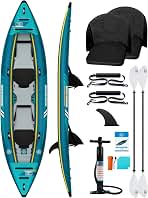
Best Overall: OCEANBROAD Inflatable Sit-in Touring Kayak
This is the boat I would buy if I could only own one, and it is the most expensive of the four for a reason. It is a sit-in touring kayak, which means an enclosed deck that sheds spray instead of letting it pool in the cockpit, and a hull shape built to hold a line rather than pivot on its own axis. If you paddle open water, a spring run with current, or a bay that kicks up in the afternoon, that is the shape you want. Fat, flat bottomed recreational inflatables turn easily and track badly, and bad tracking means tired arms by mile two.
It is also sold as a one person or two person hull, so you can run it solo on a Tuesday and put a second paddler in it on Saturday. That flexibility is worth real money if you are buying one boat for a household instead of two boats for two people.
Two things to check before you order. The listing is explicit about no HIN, so if your state registers paddlecraft, read that line twice before you buy. And confirm what is in the box, because this boat does not advertise a paddle and pump the way the others do. Factor those into the total, since a boat without a pump is not a boat you can paddle today.
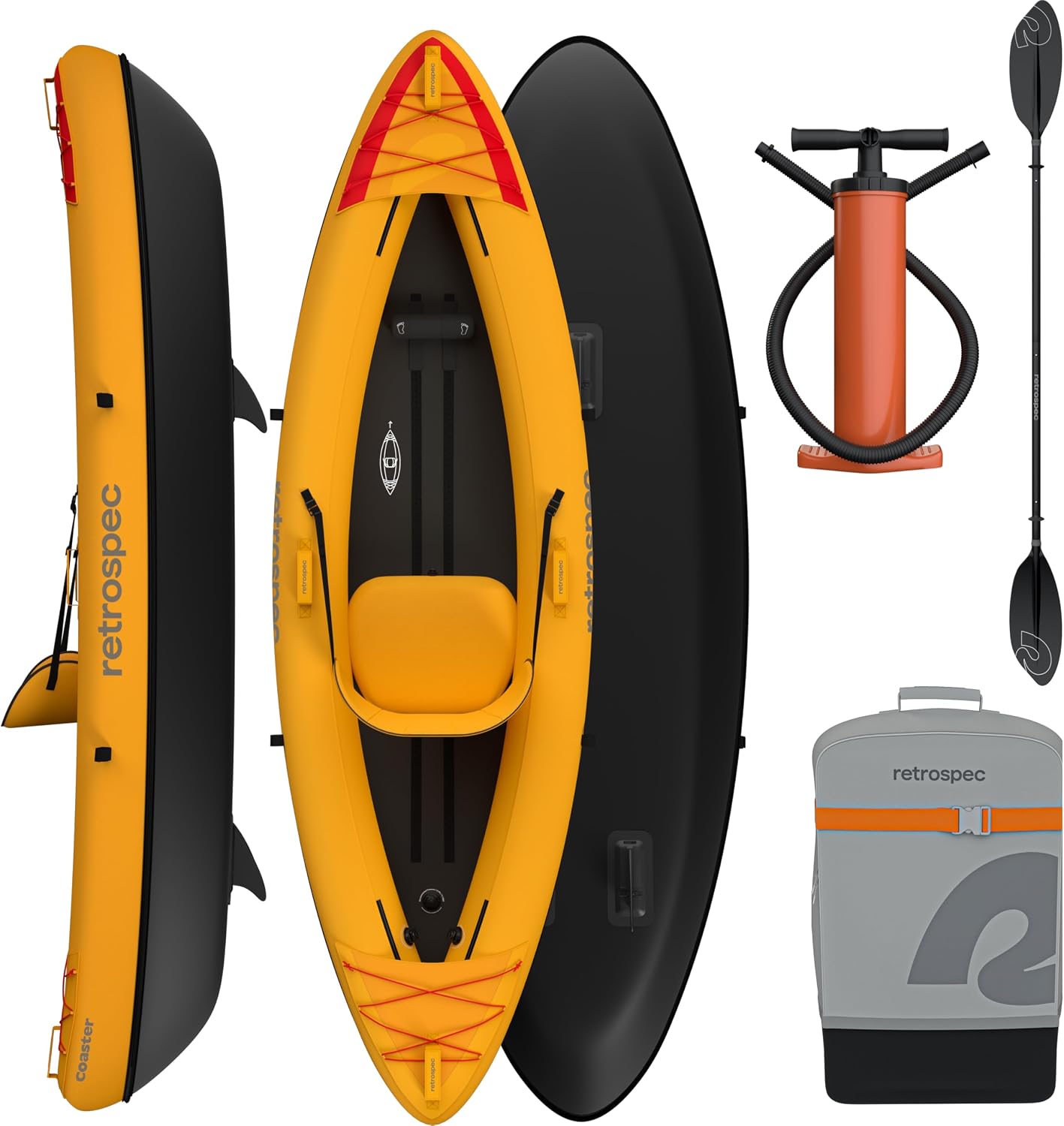
Best Tandem: Retrospec Coaster Inflatable Kayak
The Coaster is the tandem value in this group. Retrospec sells it as a single and a tandem boat, with listed capacities of 220 pounds and 440 pounds depending on the version, and it comes with a paddle, a pump, and a carry bag in the box. That last part matters more than people give it credit for. A cheap kayak plus a separate pump plus a separate paddle is rarely cheaper than one set that includes all three, and it is always more annoying to store.
The 440 pound tandem number deserves a caveat. Weight ratings are calm water numbers. Put two adults, two paddles, water bottles, and a dry bag in a tandem and you are closer to the line than the sticker suggests, and the boat will sit lower and paddle slower. That is not a defect, it is physics, but you should plan your loading around it.
The bigger question with any packable kayak is the bag. "Packs to the size of a backpack" usually means a backpack the size of a body bag once the boat is rolled and the floor is folded, and this one is no exception. Measure your trunk before you buy, not after.
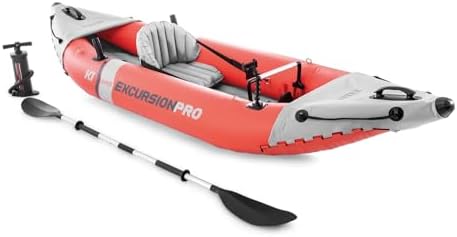
Best Solo Sit-on-Top: INTEX Excursion Pro K1
This is the solo sit-on-top set: one person, with a paddle and a pump included. If you want a boat you can drop in a lake, paddle for an hour, and hose off in the driveway, this is the category to shop in. There is no cockpit to bail, no spray skirt to wrestle with, and if you flip it you climb back on instead of swimming it to shore.
The tradeoff is that sit-on-top hulls sit higher and catch wind. On a calm morning that is nothing. On a spring run with an afternoon sea breeze pushing against you, it is a workout, and you will feel every correction stroke in your shoulders.
I would put this boat in front of a first time paddler ahead of a hardshell for one reason: setup and storage. It lives in a closet, it fits in the trunk of a sedan, and there is no roof rack to buy. What it is not is a touring boat. If your goal is distance and straight lines in current, save for the OCEANBROAD instead and skip this step entirely.
Best Budget: INTEX Challenger Inflatable Kayak
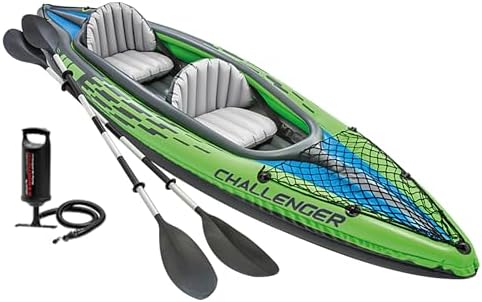
This is the budget pick, and it is the boat I keep in the garage for solo spring runs where I do not want to drag the good hull over a shallow rock bar. The set includes two 86 inch paddles, a high output pump, an adjustable seat with a backrest, a removable skeg, and a cargo storage net.
The skeg is the part people skip over in the listing. On a flat bottomed inflatable, a small deployable fin is the cheapest fix for sloppy tracking you will ever get, and it costs you nothing but the ten seconds it takes to clip it on. Deploy it on open water and leave it up in skinny water where it will drag bottom.
The hull is SuperStrong PVC, which in my experience is the material that takes a patch without drama. I have patched a cheap PVC inflatable with a bicycle tire repair kit after a submerged branch opened a two inch gash, and that patch is still holding three summers later. That is the standard I hold every hull to now, and it is the reason I will recommend a cheap PVC boat for calm water and never recommend a fragile hull at any price.
Keep it off oyster bars, out of rock gardens, and out of big wind. It is a lake and slow river boat. Treat it that way and it will outlast your expectations of a boat at this price.
How I test an inflatable kayak
Every boat gets the same three part routine, and none of it involves a spec sheet.
Setup, timed. Same hand pump, same boat ramp, three runs. I care about the third run, not the first, because the third is what a normal Saturday actually feels like when you are not being careful. If a boat cannot be inflated and on the water in a reasonable window, I stop caring how it paddles.
The stab test. I take hull material and I put a deliberate cut in it, then I patch it. A hull that takes a patch cleanly is a hull you can own for years. A hull that spreads the tear is a hull that ends up in a landfill, and no discount makes that a good deal.
The paddle. Three miles, same route, same current, same paddler. I watch how many correction strokes I make and how my shoulders feel at the end. Tracking is the whole ballgame. A pretty boat that will not hold a line in a light chop is a pool toy with better marketing.
I also pack each boat wet, in the rain, at the end of the day. That is when you find out whether the bag actually fits the boat or just fits the photo.
The comparison table
| Kayak | Best for | Seats | What's included | Price |
|---|---|---|---|---|
 Visit on Amazon → Visit on Amazon →OCEANBROAD Inflatable Sit-in Kayak |
Best overall touring | 1 or 2, sit-in deck | Not listed, confirm before buying | $505.95 |
 Visit on Amazon → Visit on Amazon →Retrospec Coaster |
Best tandem | 1 or 2, 220 and 440 lb listed capacity | Paddle, pump, carry bag | $299.99 |
 Visit on Amazon → Visit on Amazon →INTEX Excursion Pro K1 |
Best solo sit-on-top | 1 | Paddle and pump | $228.99 |
 Visit on Amazon → Visit on Amazon →INTEX Challenger |
Best budget | 1 | Two 86 in paddles, high output pump, adjustable seat with backrest, removable skeg, cargo net | $136.96 |
Should you buy the OCEANBROAD?
Yes, if you paddle open water or current and you want one hull that does solo and tandem duty. It is the most expensive option here, so buy it last, after you have confirmed you will actually use it. Check the box contents and the HIN line before you order.
Should you buy the Retrospec Coaster?
If you need a tandem and you want the paddle and pump in the same box, this is the set to look at. Plan for the bag being bigger than the marketing photo and treat the 440 pound rating as a calm water number.
Should you buy the INTEX Excursion Pro K1?
Yes, for a first boat and calm water. It is the easiest of the four to live with and the easiest to store, and the included paddle and pump mean you can paddle it the day it arrives.
Should you buy the INTEX Challenger?
Yes, for a lake, a slow river, and a paddler who wants to spend the rest of the budget on a good life jacket and a dry bag. No, if you paddle rocks, oyster bars, or big open water. That skeg helps it track, but nothing helps it bounce off an oyster bar.