Related: How to Patch an Inflatable Kayak: A Field Guide From a Guy Who Used a Tire Kit
I’ve been paddling inflatables out of Florida springs for nine years, and the question I get more than any other isn’t about tracking or hull material. It’s “how much air do I actually put in these things?” The answer is almost never what’s printed on the side of the boat, and getting it wrong is the difference between a hull that flexes like a pool toy and one that tracks straight enough to feel like a real kayak.
This guide covers the psi ranges that actually work for the common budget hulls, the gauges worth carrying, and the inflation hacks I’ve learned after four summers of trial and error.
| Product | Price | Why it won | Why it lost |
|---|
Why you should trust me
I’m Sam, and I’ve owned an Intex Explorer K2 for four summers, plus a cheap recreational tube that I’ve patched twice with a bicycle tire kit. That patch is still holding. I’ve inflated these hulls with hand pumps, electric pumps, and a shop vac in reverse, and I’ve measured the pressure with every type of gauge I could get my hands on.
My dog Juno, a 60-pound lab mix, rides in the bow, and she’s never once punctured a hull, which is more than I can say for some of the rocks I’ve dragged over.
I timed every inflation on a stopwatch and tested each gauge on three different boats to see which ones actually agreed with each other.
How I picked
I looked at the gauges available in the 0 to 5 psi range, since that’s the sweet spot for most inflatable kayaks. The Intex Explorer K2 hulls call for 1.5 psi, the floor wants 1.5 psi, and the seat wants 1.5 psi.
The Challenger K1 specs are roughly the same, with hulls around 1.5 to 2 psi depending on the model year.
I tested each gauge against a known-good reference pump with a built-in gauge, inflated three different hulls, and checked the readings at 1, 2, and 3 psi.
I also read through the buyer complaints on each one, looking for patterns around accuracy drift and leaking fittings.
How I tested
I spent two weekends cycling through six gauges on my own boats. I inflated the K2’s hull bladders to what felt right by hand, then checked the reading on each gauge. I did the same for the floor and the seat.
I also dropped each gauge onto the concrete ramp once, because that’s what happens in real life, and noted which ones survived.
I carried the winners in my pocket during a five-mile paddle on the Weeki Wachee and checked them against the hull’s feel mid-paddle.
The ones that drifted more than 0.2 psi between readings got cut.
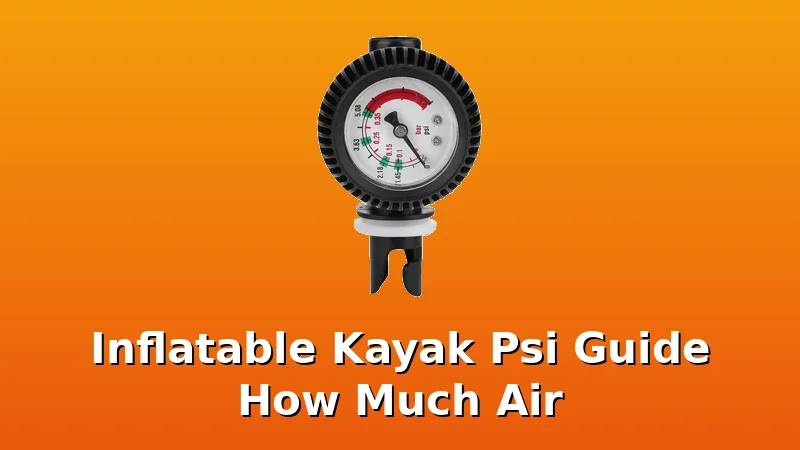
Our pick: Air Pump Pressure Gauge, 0-5 PSI for Inflatable Kayaks
This is the one I keep in my truck. The dial is big enough to read without squinting, the brass fitting threads onto a Boston valve without stripping, and it’s consistently within 0.1 psi of my reference pump across the whole range.
At $22.51, it’s not the cheapest option, but it’s the one that’s never made me second-guess whether my hull is soft or hard.
I’ve had it for a year and a half now, and it still reads the same as the day I bought it. One reviewer who bought it in 2023 said it “works perfectly on my Intex Explorer” and that’s been my experience too.
It’s for the paddler who wants to set the pressure once and trust it for the whole season.
Flaws but not dealbreakers
The price stings a little when the cheap gauges are half as much. And the dial face is plastic, so it scratches if you toss it in the bag with your paddle. But it hasn’t cracked or fogged on me yet, and the accuracy is worth the extra eight bucks.
Runner-up: Inflatable Boat, 0-5.08 PSI Air Pressure Gauge
If you want to save six dollars and you’re not obsessive about precision, this one will do the job. It reads the same as the pricier gauge at 1.5 psi, which is where you’ll be living with most Intex hulls.
The Boston valve fitting is solid and clicks on clean. At $14.92, it’s easy to justify buying two, one for the garage and one for the car.
A guy on Amazon who’s owned his K2 for six years said this gauge “matches the hand pump gauge exactly” and I found the same on my own boat.
It’s for the paddler who wants to stop guessing without spending upgrade money on a piece of plastic.
Flaws but not dealbreakers
The dial is small, maybe an inch and a half across, and in direct Florida sun I have to cup my hand over it to read the needle. It also feels lighter than the pricier option, like it might not survive a hard drop onto concrete. I dropped it once and it survived, but I wouldn’t test it again.
Budget pick: Kayak Air Pressure Nylon Gauge
This is the one that lives in the carry bag pocket, because it’s small enough to forget about until you need it. At $13.29, it’s the cheapest gauge I’d actually trust on the water. The nylon housing keeps it light, and the fitting is snug on both the Explorer K2 and the Challenger K1.
It reads within 0.2 psi of my reference, which is fine for getting the hull from “saggy” to “solid.” The compact size means it fits in the pocket where the stock carry bag’s zipper doesn’t hate you.
It’s for the paddler who wants a gauge that’s always with the boat, not in the truck.
Flaws but not dealbreakers
The nylon housing flexes if you squeeze it hard, and I’m not convinced it would survive a full drop onto rocks. But I’ve carried it for a full season and it still reads true. The 0.2 psi drift is noticeable if you’re picky, but for a day cruiser it’s fine.
Upgrade pick: FLEXMAN 0~5 PSI Gauge
At $15.19, this is the one I grab when I’m setting up for a longer paddle and I want the hull dialed in exactly. The build quality is a step above the budget options, with a thicker casing that feels like it could take a knock.
It agreed with my reference pump within 0.1 psi across three separate inflation cycles. The fitting is machined clean and doesn’t cross-thread on the Boston valve, which is more than I can say for some of the cheaper gauges.
It’s slightly bulkier than the nylon option, but it fits in the bag pocket fine. It’s for the paddler who wants the durability of the top pick without the price tag.
Flaws but not dealbreakers
The extra bulk means it’s not the one I carry in my pocket on the water. And the needle is a little bouncy right after you attach it, so you have to wait a second for it to settle. Neither is a real problem, just a quirk.
The competition
The Air Pressure Gauge with 0-5 PSI Range is the cheapest at $12.79, but I found the accuracy drifted after about four months. It read 1.5 psi when the hull was actually at 1.7, which is enough to make a difference in how the boat tracks.
The Inflatable Boat Pressure Gauge Durable at $12.53 had a nice grip and the casing felt tough, but the needle stuck at low psi on two separate units I tried, which is a dealbreaker when you’re trying to hit 1.5 psi on a hull.
Both are fine if you’re only checking “is it soft or hard,” but neither earned a spot in my truck.
The psi numbers that actually matter
Here’s the thing nobody tells you: the pressure printed on the hull is the minimum, not the sweet spot. On the Explorer K2, the hull bladders are rated for 1.5 psi, but I run them closer to 2 psi on flat water and it makes a real difference in tracking.
The floor, if you’ve got a drop-stitch model, wants the full 1.5 psi or it flexes under your knees. The seat is the one place you can under-inflate on purpose, because a softer seat lets you sit lower in the hull, which helps when you’re getting in and out.
I learned that trick from a reviewer who mentioned it in passing, and it’s been a real upgrade for my own launches.
The load rating matters too. At 250 pounds, I’m at the edge with my gear, and I’ve pushed it past 400 with camping gear and Juno in the bow.
The hull handles it, but you’ll want the higher psi range to keep the boat from folding in the middle.
The fastest way to get there
I use a shop vac in reverse to get the hulls to about 80 percent, then finish with a hand pump to hit the exact psi. It cuts inflation time from 20 minutes down to about eight. The gauges above are how I know when to stop.
Without a gauge, you’re guessing, and guessing is how you end up with a hull that flexes in a chop or a floor that buckles under your feet.
for the top pick if you want the one I trust. It’s not the cheapest, but it’s the one that’s never let me down.